

 Türkçe
 Deutsch
 Français
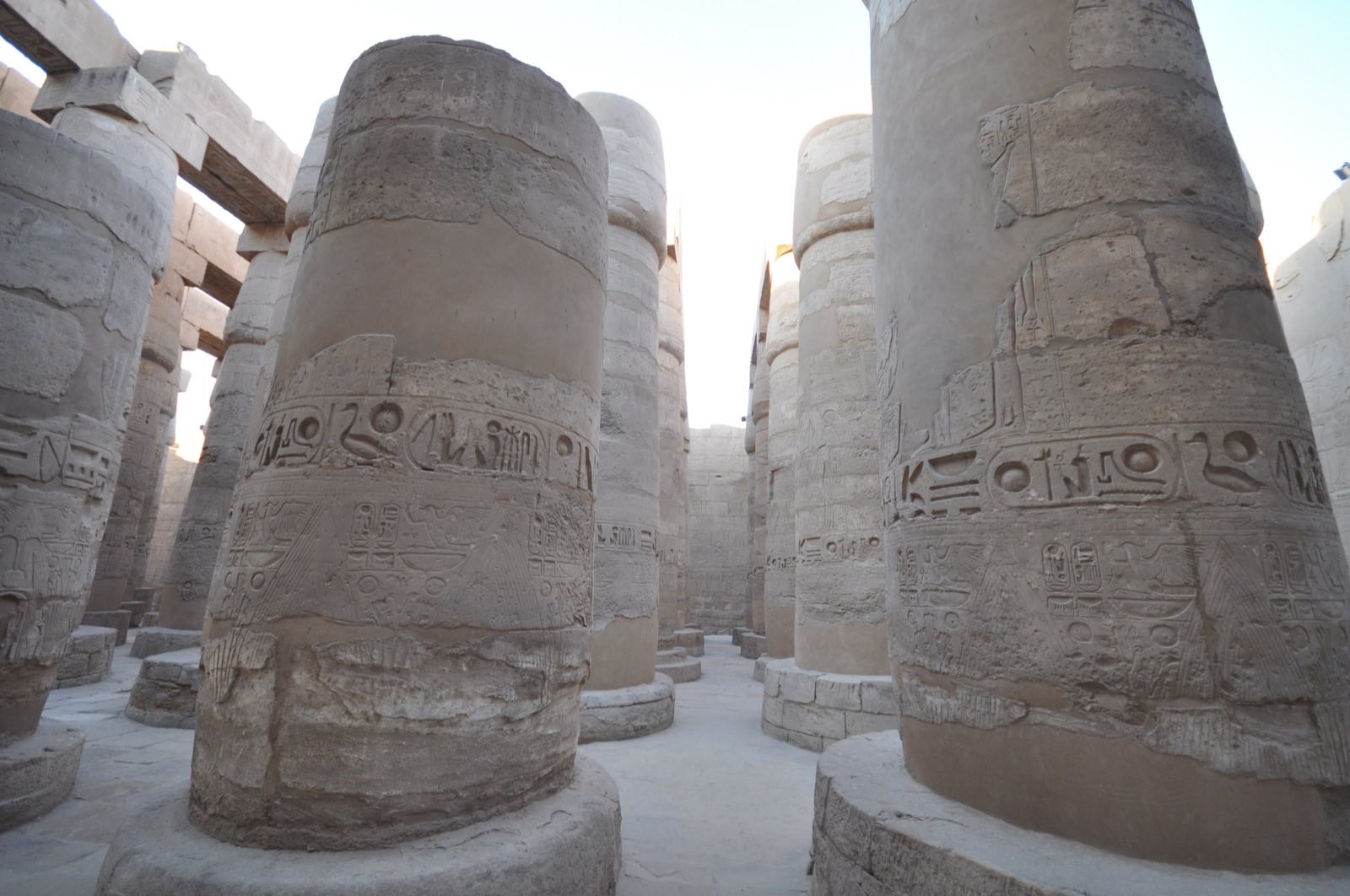
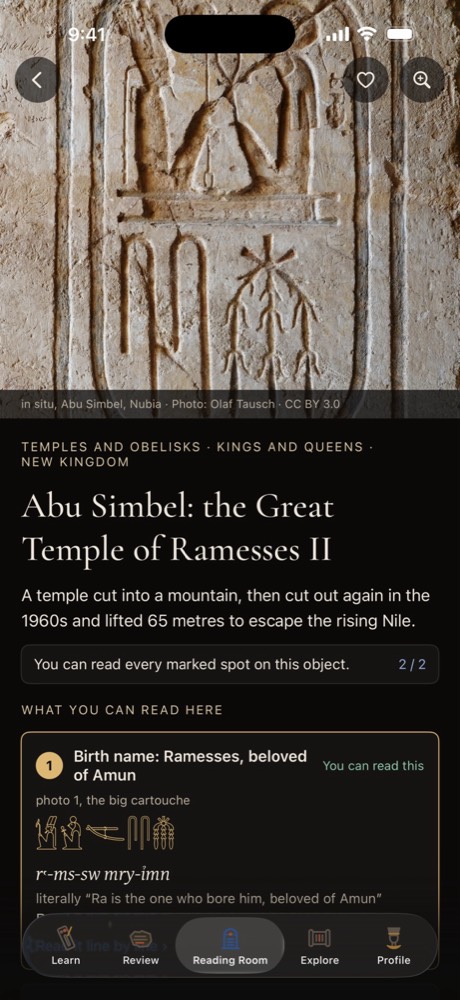
From one sign
to the stone itself.
Sesh teaches reading the way the grammars build it, one layer at a time. Each step below is a real example from the course, with the lesson where you meet it. Every layer is used at once on the last step: a real inscription, read on the object.
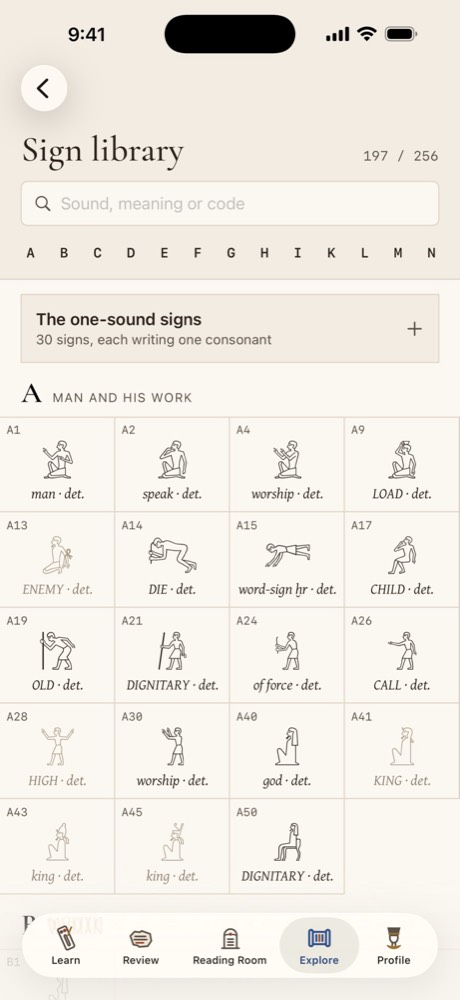
Know a sign by its shape and its Gardiner code. The sign library holds all 256 signs of the course.
A placenta (Gardiner, with a question mark), a quail chick, a horned viper: three sounds, learned on a real name.
“good, beautiful”. One of 846 words, each with its sound, its meaning and where you met it.
“son of Ra”: two nouns side by side, no word for “of”. Gardiner §85 p. 65; Allen p. 83.
“eternity”: two sound signs, then a strip of land you do not read aloud. It closes the word and hints at its sense.
“an offering which the king gives”: the opening of the commonest inscription in Egypt.
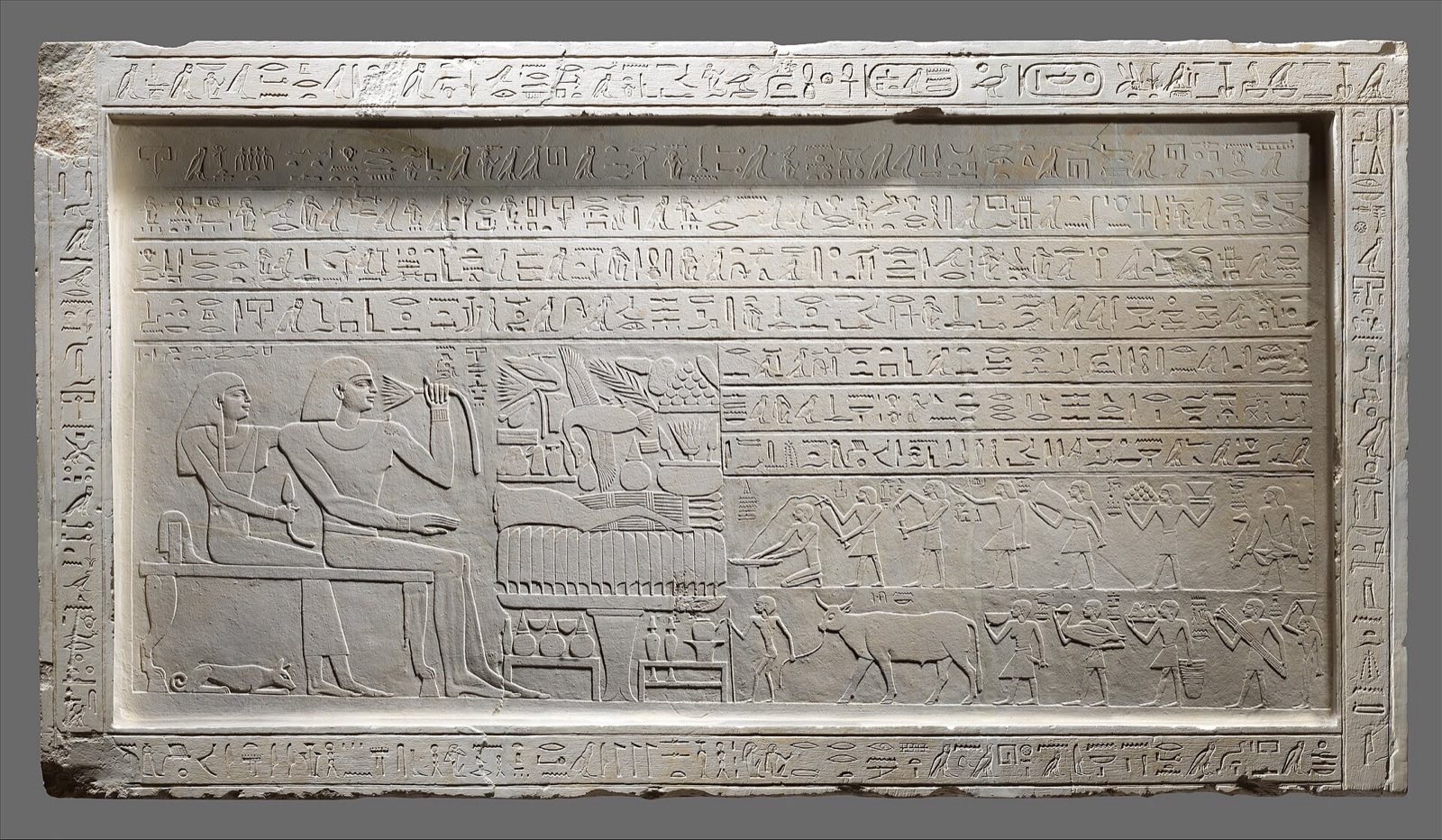
“King of Upper and Lower Egypt”, read on the top band of the stela of Intef, about 4,000 years old.
Learn.
Ten minutes a day.
231 lessons in 32 units and four stages, from the name of Khufu to the Story of Sinuhe in the original. Each lesson takes four to twenty minutes and ends on something real.
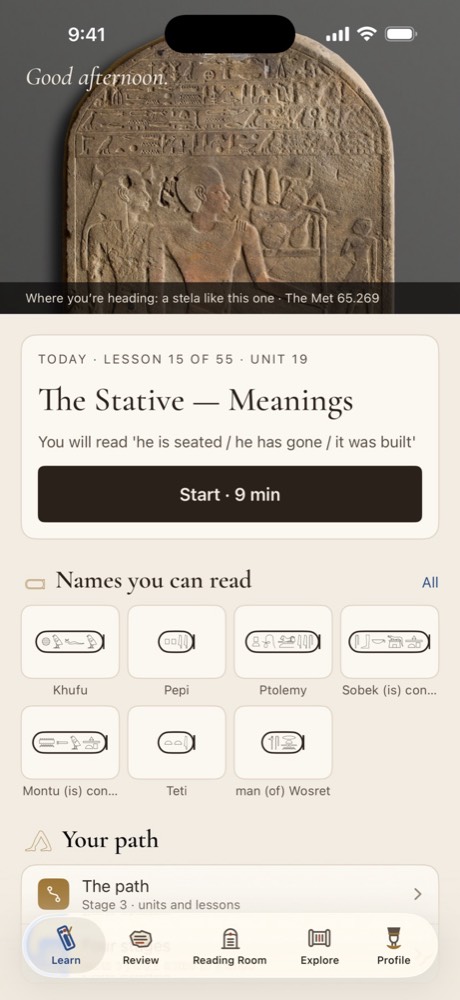
Today’s lesson, on a real object
The Learn tab shows where you are heading, today’s lesson with its length and its goal, and the royal names you can already read. Each lesson opens by telling you how long it takes, how many exercises it has, and what you will be able to read by the end.
There are five kinds of lesson: Signs, Grammar, Read it yourself, Reading, and a Certificate reading at the end of each stage. The first nine lessons, units 1 and 2, are free.
- “You will read ‘he is seated / he has gone / it was built’”: every lesson names its goal before it starts.
- Lesson 1 takes four minutes. Most take seven to nine; whole readings up to twenty.
- The path shows every unit and lesson of your stage.
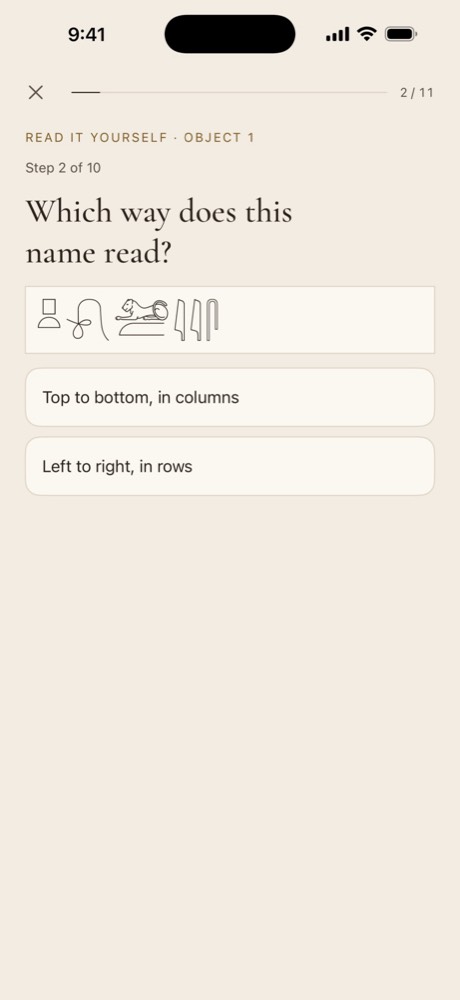
Thirty lessons that end on a museum object
Thirty times in the course a lesson hands you a real object and walks you through it step by step: which way the signs face, which way the text reads, which signs you know, and finally what it says. Object 1 is a Ptolemaic menat in Lesson 9, still in the free part.
- Step by step, ten steps or more: direction, signs, sounds, words, translation.
- Wrong answers explain themselves, so a mistake teaches.
- Each object you read stays open in the Reading Room.
256 signs. 846 words. All searchable.
Every sign of the course sits in the sign library, ordered by Gardiner’s groups (A, man and his work; G, birds; N, sky and water) with its code, its sound or job, what it shows and the lesson where you met it. Search by sound, meaning or code, or draw the sign roughly to find it by shape.
The dictionary lists every course word in Faulkner’s order. Explore also holds the grammar reference (every construction, with the lesson that teaches it), every king and queen in the course in time order, and the concept cards from your lessons.
- Find a sign by shape: “Draw the sign roughly, or pick what it looks like.”
- Uncertain identifications say so: for 𓐍 the sign list gives Gardiner’s, Allen’s and Manley’s views.
- Learning with a book? Pick your grammar and see which Sesh lessons teach each section.
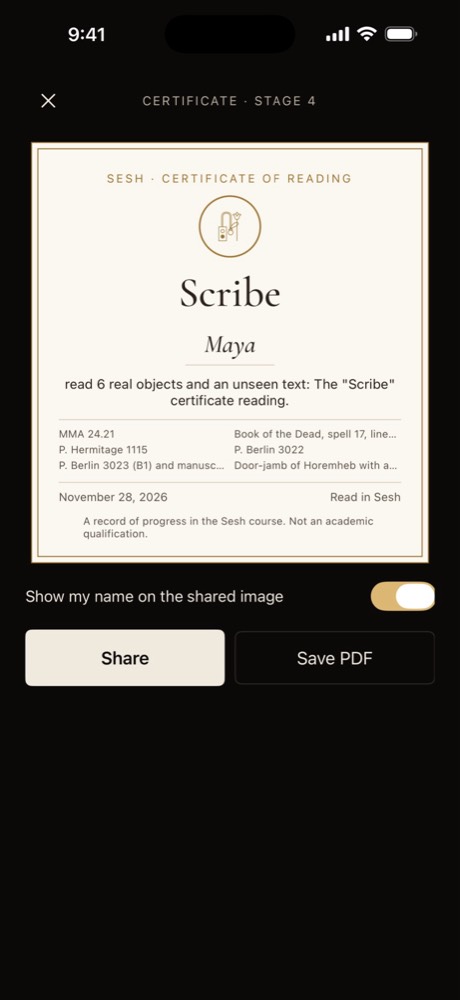
Four stages. Four certificates.
Each stage ends with a certificate reading: a text you have never seen, read on your own. Pass it and you earn Reader I, Reader II, Translator or Scribe, with the objects and texts you read listed on the certificate.
The certificate says what it is: “A record of progress in the Sesh course. Not an academic qualification.” You can share it as an image or save it as a PDF.
- Reader I closes Stage 1, after a whole Middle Kingdom stela.
- Reader II: an unseen stela. Translator: an unseen Middle Egyptian text.
- Scribe: a text you have never seen, at the end of Stage 4.
Read.
Real texts, every line explained.
The Reading Room holds 132 objects from museums and temples, and the Reading ladder 42 passages of real texts. Everything opens as you learn what it needs.
Masterpieces you will read yourself
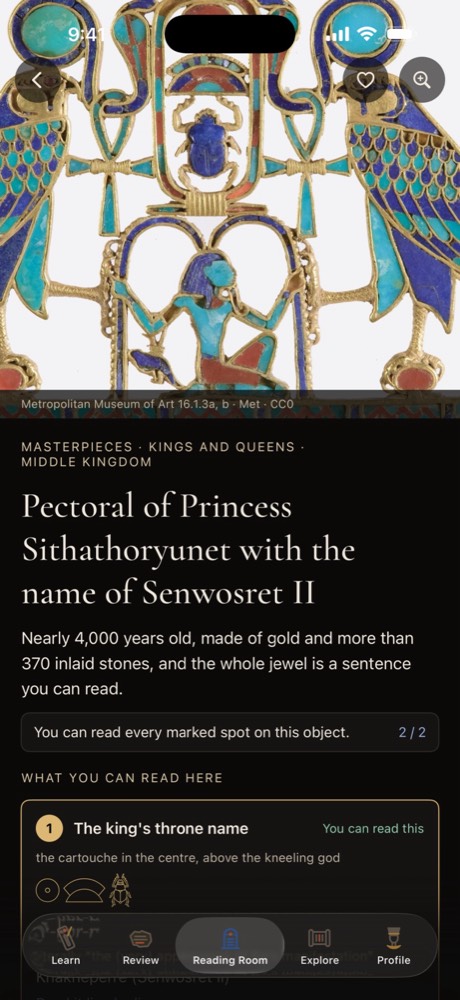
Each object comes with its museum number, a short story, what to look for at a glance, and the lines you can read on it, marked on the photograph. A counter tells you how much of it you can read today: on the pectoral of Sithathoryunet, every marked spot is readable after Lesson 31.
- Marked spots on the photo, numbered in reading order.
- Each line: the signs, their sounds, word by word, then a natural translation.
- Lines you have not learned yet say which lesson opens them.
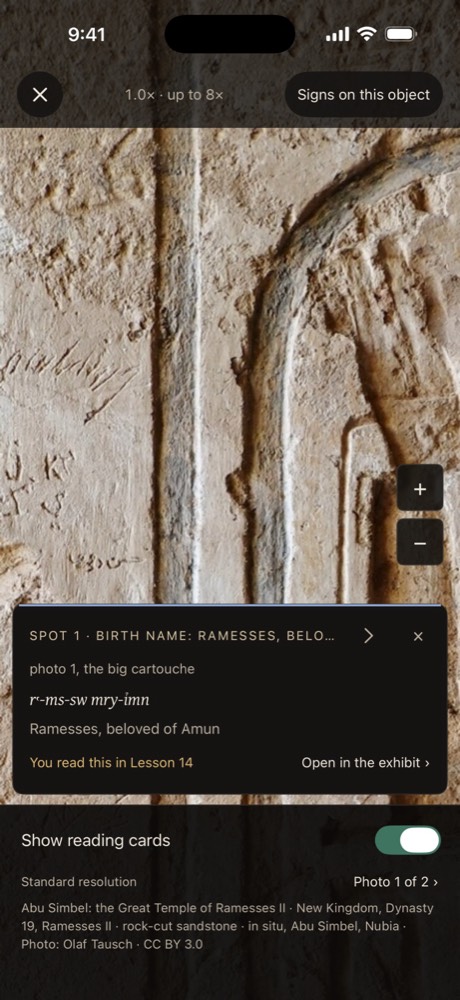
Look closely. Up to eight times.
Zoom into the photograph up to 8× and the reading cards follow you: tap a marked spot and the card shows the label, the transliteration, the translation and the lesson where you learned it. “Signs on this object” lists every sign you can find there.
- Reading cards can be switched off to look at the stone alone.
- Several photos per object where the museum offers them.
- Every photo shows its credit and licence.
42 passages, easy to hard
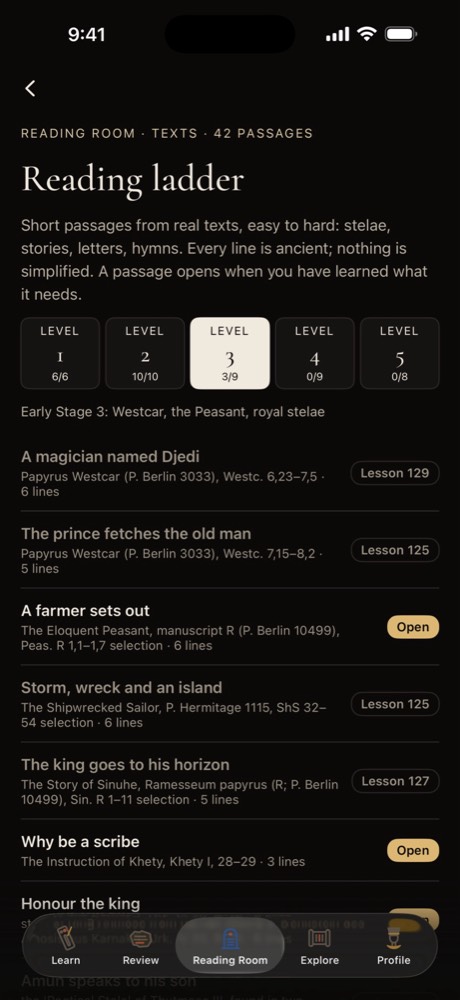
Short passages from real texts in five levels: coffins and stelae first, then stories, royal stelae, whole episodes, and finally letters, hymns, medicine and law. In the app’s words: “Every line is ancient; nothing is simplified.”
A passage opens when you have learned what it needs. You read it line by line, with the meanings revealed when you tap.
- Level 1 opens after the Stage 1 grammar.
- Sources named for every passage: Papyrus Westcar, the Shipwrecked Sailor, the Heqanakht letters, Papyrus Ebers.
- “Readings follow Allen, Gardiner and the Collier & Manley key; translations are ours.”
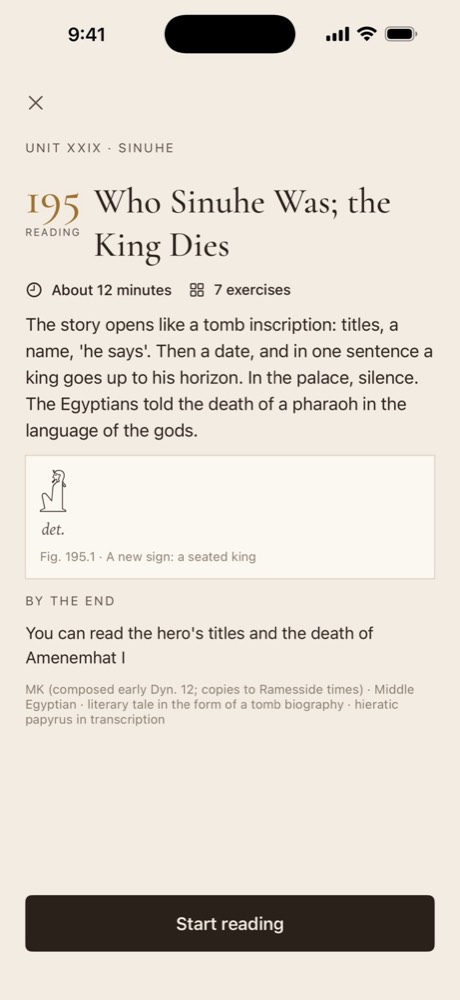
The Story of Sinuhe, in eleven lessons
Stage 4 reads the great texts themselves: the Book of the Dead, the Shipwrecked Sailor, the Eloquent Peasant, hymns and wisdom, letters and a medical prescription. Unit XXIX is Sinuhe, from the death of Amenemhat I to the hero’s homecoming, ending with a passage new to you, read unaided.
- Each reading lesson gives its time, its exercises and what you will read by the end.
- New signs are introduced where they appear in the text.
- Hieratic, Demotic and Coptic are explained in Unit XXV.
Review.
Weigh your memory.
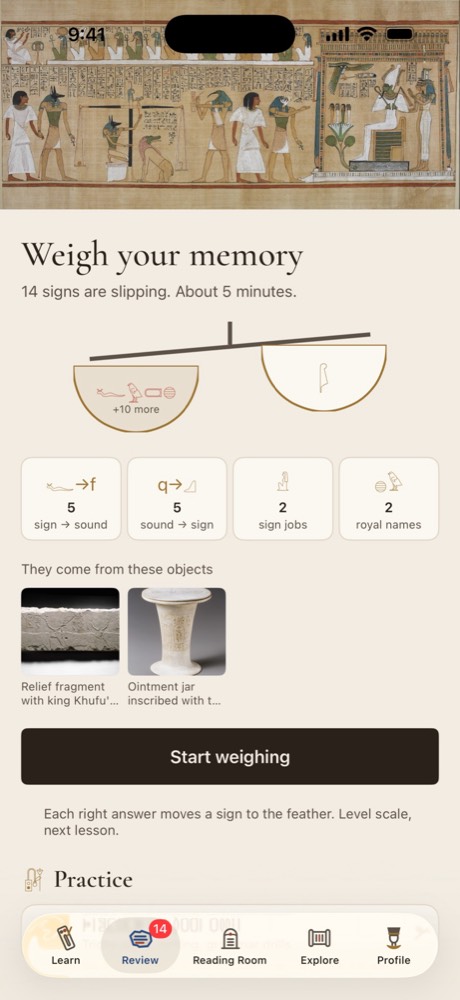
On Hunefer’s papyrus a heart is weighed against the feather of Maat. In Sesh it is your memory on the scale: spaced review brings each sign back just as you are about to forget it.
The scale of Maat
Review shows how many signs are slipping and how long the session will take. Each right answer moves a sign to the feather; a level scale means you are ready for the next lesson. Signs are tested from sign to sound and from sound to sign, and royal names come back to be read again.
Review comes first: “Memory first: new lessons wait until these are done.” The screen also shows which objects the signs came from.
- Practice: extra rounds on what you already know, whenever you like.
- Tricky signs: pairs that keep slipping, compared side by side.
- Catch-up mode after a long break.
Write.
Your name, and your own lines.
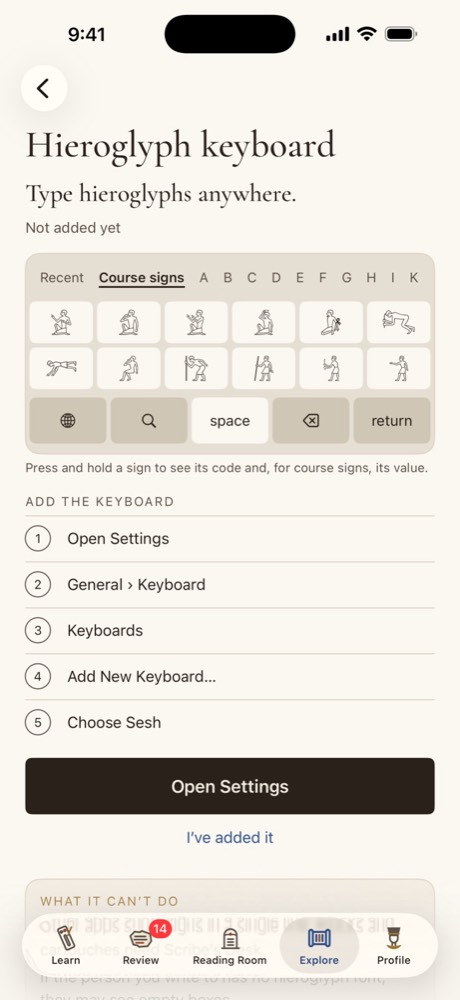
Spell a name in signs, type hieroglyphs in any app, compose text in blocks on the Scribe’s Desk, or practise drawing the signs with your finger.
A name, the scribe’s way
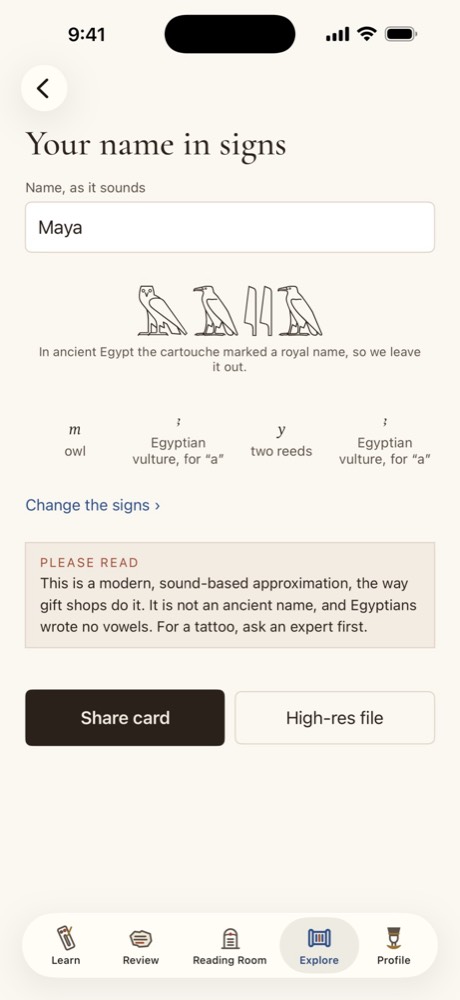
Type a name as it sounds and Sesh spells it sound by sound in one-sound signs, inside a cartouche if you like. You confirm every sound, change any sign, and share it as a card, a story image or a high-resolution PNG. Premium adds a vector SVG and a tattoo outline.
An honesty card sits under every name and cannot be dismissed: “This is a modern, sound-based approximation, the way gift shops do it. It is not an ancient name, and Egyptians wrote no vowels. For a tattoo, ask an expert first.”
- Sound-by-sound breakdown under the signs.
- Seated man or seated woman after the name, as the Egyptians wrote it.
- Reads English, Turkish and other European spellings by sound.

A translator converts.
Sesh teaches you to read.
Both are useful, and they answer different questions. A translator tells you what a text says. A course teaches you how to find out, so that the next text is one you can read yourself.
Palm rib + t + round sign = 'Regnal Year', then the number. Learn it as one label. Its reading is disputed: Gardiner has ḥꜣt-sp, Allen rnpt-ḥsb, and C&M rnpt-sp. We write ḥꜣt-sp throughout, with a 'reading disputed' badge.
No AI readings.
No guesswork.
The course has 409 grammar rules, and every one names its source. When the books disagree, Gardiner, Faulkner and Allen come first, and Leprohon for royal names. Inscriptions on objects are checked against the museum’s record and photograph. No image in Sesh is AI-generated.
See the full method on the Curriculum page ›
A native iOS app for iOS 17 or later.
All lessons, signs, words and objects are on your device. No account needed.
English, Turkish, German and French, for lessons and the whole app.
Free to download, with Lessons 1–9 free. Sesh Premium unlocks everything, as a subscription or a one-time lifetime purchase; prices are shown in the App Store in your currency.
The only app on the App Store that takes you from your first hieroglyph to the Story of Sinuhe in the original.

