
 Türkçe
 Deutsch
 Français
Egyptian determinatives, explained
A determinative is a silent sign at the end of a hieroglyphic word that shows what kind of thing the word means: a man, a woman, a god, a town, an action, an abstract idea. It is not pronounced and not transliterated. Because Egyptian was written without spaces, determinatives also show where one word ends and the next begins.
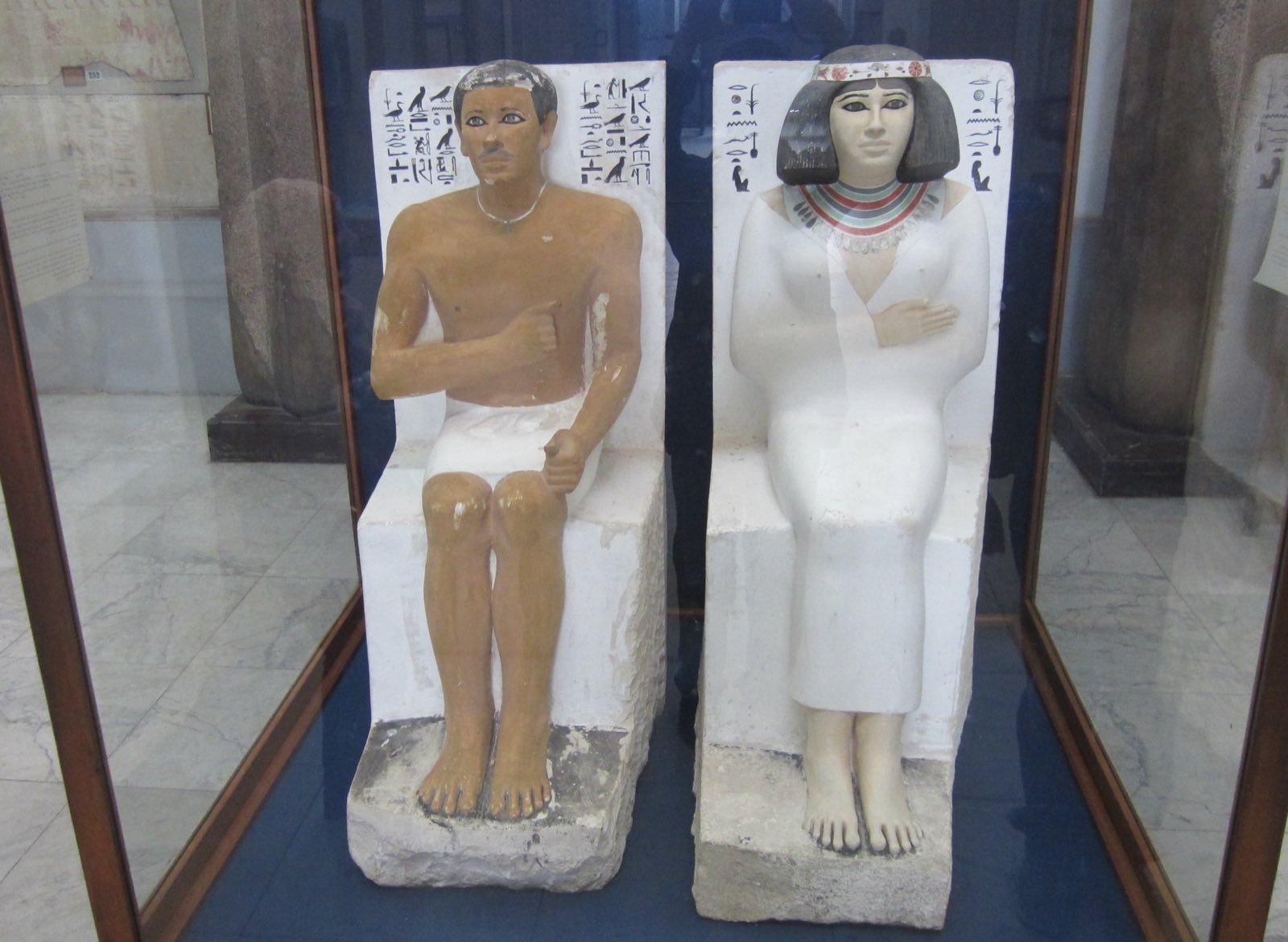
Read a few lines of hieroglyphs and you notice the same small figures again and again at the ends of words: a seated man, a seated woman, three hills, a papyrus roll. They are not spelling anything. They are telling you what kind of word you have just read.
This guide is about those signs. For the basics of sound signs, direction and transliteration, see the cornerstone guide, How to read Egyptian hieroglyphs.
01What a determinative is
Hieroglyphic signs do different jobs. Some write sounds, one, two or three consonants at a time. Some write a whole word. And some are determinatives: meaning signs that are not read aloud, placed after a word to show which class of thing it belongs to (Gardiner §§23–24). A seated man marks a male person, a house plan a building, a papyrus roll something you cannot touch, such as knowledge or truth.
Egyptian writing records consonants, not vowels, so many different words share the same letters on the page. Determinatives are one of the ways the writing system copes with this. They also work as visual punctuation, because a hieroglyphic text has no spaces between words.
02Silent, and usually last
Three rules cover most cases:
- A determinative is never pronounced and never transliterated. The word 𓌢𓈖𓀀 is simply sn “brother”: the seated man has no sound value in it.
- It stands at the end of the word, after the sound signs. Endings that belong to the word come before it: the feminine -t of snt “sister”, and the -t of infinitives such as mrt “loving” (Collier & Manley §31 p. 52).
- A word can have none, one or several. Short, common words often have none; others pile up two or three to make the sense unmistakable (Gardiner §23).
03Common determinatives
The list below gives some of the determinatives you will meet most often, with their numbers in Gardiner’s sign list. Gardiner sorted the signs by what they picture: A for men and their activities, B for women, D for parts of the body, G for birds, N for sky, earth and water, O for buildings, Y for writing, Z for strokes. Allen’s sign list keeps Gardiner’s numbers, adding a few signs of its own, so a code like D40 means the same sign in both books. Each example word is taken from the Sesh dictionary.
| Sign | Code | What it shows | Marks words for | Example |
|---|---|---|---|---|
| 𓀀 | A1 | seated man Allen p. 467 | man, person | 𓌢𓈖𓀀 sn “brother” |
| 𓁐 | B1 | seated woman Allen p. 470 | woman | 𓅐𓏏𓁐 mwt “mother” |
| 𓀁 | A2 | seated man with his hand to his mouth Allen p. 467 | speak, eat, drink, think, feel | 𓆓𓂧𓀁 ḏd “say” |
| 𓀭 | A40 | seated god with curved beard Allen p. 469 | god; also king | 𓊨𓁹𓀭 wsỉr “Osiris” |
| 𓀗 | A19 | bent man leaning on a stick Allen p. 468 | old, distinguished | 𓇋𓄿𓀗 ỉꜣw “old man” |
| 𓀢 | A30 | man with both hands raised Allen p. 469 | worship, respect | 𓇼𓄿𓀢 dwꜣ “adore, praise” |
| 𓀔 | A17 | seated child, finger to mouth Allen p. 468 | child, young | 𓄡𓂋𓂧𓀔 ẖrd “child” |
| 𓂡 | D40 | forearm holding a stick Allen p. 473 | action, force, effort | 𓆑𓄿𓀋𓂡 fꜣ(ỉ) “carry, lift up” |
| 𓂻 | D54 | walking legs Allen p. 474 | motion | 𓌞𓋴𓂻 šms “follow” |
| 𓅪 | G37 | sparrow Allen p. 481 | small, bad | 𓃀𓇋𓈖𓏏𓅪 bỉnt “what is bad, evil” |
| 𓈉 | N25 | range of three hills Allen p. 487 | desert, foreign land | 𓋀𓏏𓈉 ỉmnt “the West” |
| 𓊖 | O49 | crossroads in a round settlement Allen p. 491 | town, place | 𓆎𓏏𓊖 Kmt “Egypt” |
| 𓉐 | O1 | plan of a house Allen p. 489 | buildings | 𓇋𓇩𓉐 ỉs “tomb” |
| 𓊛 | P1 | boat on water Allen p. 491 | boats | 𓂙𓈖𓊛 ẖnỉ “row (a boat)” |
| 𓊭 | Q6 | coffin Allen p. 492 | burial | 𓈎𓂋𓋴𓊭 qrs “bury” |
| 𓏛 | Y1 | rolled and tied papyrus Allen p. 504; Gardiner p. 533 | writing; abstract ideas | 𓂋𓐍𓏛 rḫ “know” |
| 𓏥 | Z2 | three strokes Allen p. 505; Gardiner §73 | plural (a silent marker) | 𓂋𓅓𓆟𓏥 rm(w) “fish (plural)” |
Some of these signs also have other jobs. The house plan 𓉐 is a determinative in ỉs “tomb”, but with a single stroke, 𓉐𓏤, it writes the whole word pr “house”. The three hills 𓈉 close ỉmnt “the West” as a determinative, and on their own write ḫꜣst “foreign land”. Which job a sign is doing depends on the word it stands in.
04How determinatives tell words apart
Because only consonants are written, two different words can look the same until their final sign. Here the determinative is doing real work.
The same principle sorts gods from people. Spelled s-b-k and closed by a crocodile on a shrine, 𓋴𓃀𓎡𓆋, the word is the god Sobek. A personal name built on Sobek is closed instead by the seated man 𓀀, and inside a cartouche it belongs to a king (Allen pp. 467, 482; Gardiner p. 74).
05How determinatives show where words end
Egyptian texts run on without spaces or punctuation. When you meet a line for the first time, the determinatives are the easiest landmarks: each one usually closes a word, so they break the line into pieces you can work on.
06Reading with determinatives
- Find them first. Before you sound anything out, look for the meaning signs. They split the line into words.
- Use them to guess the field. Walking legs suggest a verb of motion, a hand to the mouth speech or eating, a papyrus roll an abstract idea. You know roughly what the word means before you look it up.
- Leave them out of the transliteration. Dictionaries such as Faulkner’s list words by their consonants, so determinatives play no part in finding a word.
- Expect variation. The same word can have a different determinative, or none, on another object.
Determinatives are also a good way into the culture. The classes the Egyptians chose, such as “foreign land”, “small and bad” or “abstract idea”, show how their scribes sorted the world. For the special frame that marks royal names, read The Egyptian cartouche.
 How Sesh helps
Every determinative, in context
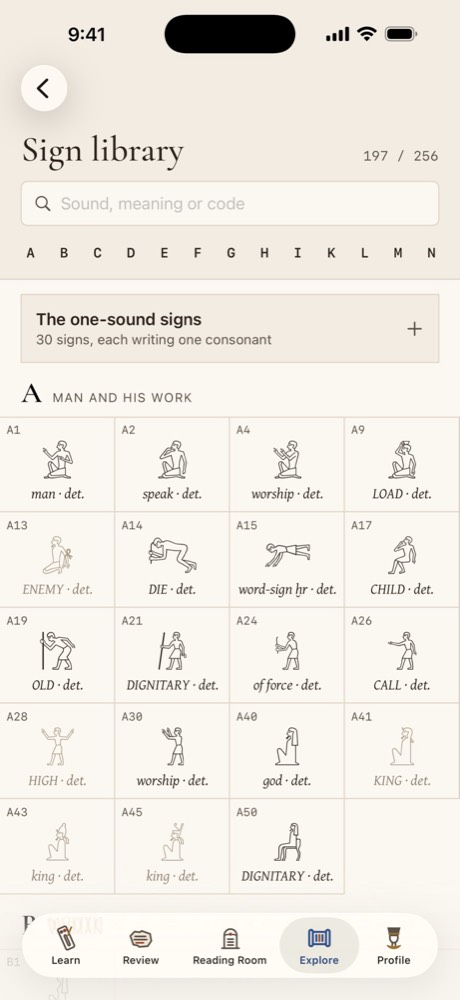
Sesh introduces determinatives the way they appear on real objects: the egg after Cleopatra’s name in lesson 8, the seated man in lesson 16, the god, town and papyrus roll in lesson 24, and dozens more as the texts get harder. Each one is taught with its Gardiner number, what it pictures and the word you met it in.
- The sign library lists all 256 signs in the course by Gardiner category, with determinatives marked “det.”
- Spaced review (“Weigh your memory”) brings each sign back just as you are about to forget it.
- Each grammar point cites its source in Gardiner, Allen, Faulkner or Collier & Manley.
iPhone and iPad · iOS 17 or later
References
- Gardiner, Alan H. Egyptian Grammar: Being an Introduction to the Study of Hieroglyphs. 3rd edition, revised. Oxford: Griffith Institute, Ashmolean Museum, 1957.
- Allen, James P. Middle Egyptian: An Introduction to the Language and Culture of Hieroglyphs. 3rd edition. Cambridge: Cambridge University Press, 2014.
- Faulkner, Raymond O. A Concise Dictionary of Middle Egyptian. Oxford: Griffith Institute, 1962.
- Collier, Mark, and Bill Manley. How to Read Egyptian Hieroglyphs: A Step-by-Step Guide to Teach Yourself. Revised edition. London: British Museum Press, 1998.
- Sesh: Learn Hieroglyphs (iOS app), course, Reading Room and sign library content, version of November 2026. Each lesson card names its source in the works above. Sign list (signs.json) and dictionary (words.json); lessons L08, L16, L19, L24, L25, L37, L82.
Sesh app content cited as “Sesh, lesson L…” or “Sesh Reading Room” is the app’s own teaching text, itself sourced to the works above. Photos are credited under each image. Not affiliated with the museums shown.