
 Türkçe
 Deutsch
 Français
The Gardiner sign list.
The Gardiner sign list is the catalogue of hieroglyphs in Alan Gardiner’s Egyptian Grammar. It sorts the signs into 26 groups by what they depict, lettered A to Z plus Aa, and numbers them within each group, so every sign has a short code: A1 is the seated man, G17 the owl, N5 the sun. Grammars, dictionaries and computer fonts still use those codes.
When an Egyptologist writes “G17”, every other Egyptologist knows it means the owl. That shared shorthand comes from one book.
01What the sign list is
Sir Alan Gardiner’s Egyptian Grammar is the classic English grammar of Middle Egyptian. At the back of the book is a long Sign-list: the hieroglyphs in common use, sorted by what they depict rather than by sound. People come first, then gods, parts of the body, animals, plants, the sky, buildings, boats, furniture, crowns, weapons, tools, rope, pots, bread, writing equipment and abstract strokes. A final group holds the signs that fit nowhere else.
For each sign Gardiner describes what it shows, as far as he could tell, and lists its uses: as a sound, as a word, or as a silent sign that classifies a word, with example words. Where he was unsure he said so. Next to the sign 𓐍 he wrote “placenta (?)”, question mark included.
The list belongs to a grammar of Middle Egyptian, the classical stage of the language, so it was built around the signs of that stage. For what Middle Egyptian is, see What is Middle Egyptian?
02How a code works
Every sign gets a code of two parts: a letter for its group and a number for its place in that group. A1 is the first sign of group A, man and his occupations: the seated man. G17 is the seventeenth bird, the owl. N5 is the fifth sign of sky, earth and water, the sun disk. The last group uses a double letter, Aa, so its first sign is Aa1.
A code says nothing about sound. G1, the vulture, writes ꜣ; G17, the owl, writes m. Both are birds, so both live in G. That is the point of the system: you can look a sign up by its look before you know what it says.
03The 26 groups
Here are Gardiner’s groups with his own headings, one example sign from each, and how many signs from that group Sesh teaches. There is no group J.
| Group | Gardiner’s heading | Example | Shows · value | In Sesh |
|---|---|---|---|---|
| A | Man and his occupations | 𓀀 A1 | seated man silent: a man | 19 |
| B | Woman and her occupations | 𓁐 B1 | seated woman silent: a woman | 1 |
| C | Anthropomorphic deities | 𓁦 C10 | goddess with a feather Maat | 3 |
| D | Parts of the human body | 𓂋 D21 | mouth r | 22 |
| E | Mammals | 𓃒 E1 | bull kꜣ “bull”; cattle | 9 |
| F | Parts of mammals | 𓄂 F4 | front part of a lion ḥꜣt “front” | 17 |
| G | Birds | 𓅓 G17 | owl m | 24 |
| H | Parts of birds | 𓆄 H6 | ostrich feather mꜣꜥt “Maat” | 3 |
| I | Amphibious animals, reptiles, etc. | 𓆑 I9 | horned viper f | 8 |
| K | Fishes and parts of fishes | 𓆟 K5 | fish silent: fish | 1 |
| L | Invertebrata and lesser animals | 𓆣 L1 | scarab beetle ḫpr | 2 |
| M | Trees and plants | 𓇋 M17 | flowering reed ỉ | 13 |
| N | Sky, earth, water | 𓇳 N5 | sun disk rꜥ “sun, Ra” | 20 |
| O | Buildings, parts of buildings, etc. | 𓉐 O1 | plan of a house pr “house” | 12 |
| P | Ships and parts of ships | 𓊛 P1 | boat on water silent: boat | 5 |
| Q | Domestic and funerary furniture | 𓊪 Q3 | stool p | 4 |
| R | Temple furniture and sacred emblems | 𓊹 R8 | cloth on a pole nṯr “god” | 9 |
| S | Crowns, dress, staves, etc. | 𓋴 S29 | folded cloth s | 13 |
| T | Warfare, hunting, butchery | 𓌉 T3 | mace with a round head ḥḏ “white” | 12 |
| U | Agriculture, crafts, and professions | 𓌻 U7 | hoe mr “love” | 12 |
| V | Rope, fibre, baskets, bags, etc. | 𓎛 V28 | wick of twisted flax ḥ | 13 |
| W | Vessels of stone and earthenware | 𓎼 W11 | jar stand g | 11 |
| X | Loaves and cakes | 𓏏 X1 | loaf of bread t | 3 |
| Y | Writings, games, music | 𓏞 Y3 | scribe’s kit sš “scribe” | 4 |
| Z | Strokes, signs derived from hieratic, geometrical figures | 𓏤 Z1 | single stroke “the thing shown” | 8 |
| Aa | Unclassified | 𓐍 Aa1 | uncertain ḫ | 8 |
Some headings are worded in the English of 1927, when the grammar first appeared: “Invertebrata and lesser animals” covers the scarab and the bee. Sesh’s sign library shortens them (“Insects and small animals”), but the letters are the same.
04Where the codes are used
- In grammars and dictionaries. Allen’s Middle Egyptian and Collier & Manley’s How to Read Egyptian Hieroglyphs refer to signs by Gardiner number, so a learner can move between books without confusion.
- In teaching. A teacher can write “D21” on a board instead of drawing a mouth. Students learn the common codes the way musicians learn note names.
- In computers. The Unicode standard, which lets your phone display 𓀀, names its characters after Gardiner’s list: that sign is “EGYPTIAN HIEROGLYPH A001”. Hieroglyphic typing systems such as the Manuel de Codage also use the codes, so typing A1 gives you the seated man.
If you write down a sign you have seen in a museum, writing its code next to it means anyone can check it later.
05Finding a sign yourself
Faced with an unknown sign on a stela, ask what it is a picture of, and go to that group.
Some identifications are guesses, so a sign is not always where you would put it. 𓏠 Y5, the sign for mn, is a senet board, a game, so it sits with writing, games and music.
06What the list cannot do
- It is a Middle Egyptian list. Inscriptions of the Old Kingdom and, above all, the temple texts of the Ptolemaic and Roman periods use many signs that Gardiner did not include.
- It is grouped by appearance, and appearances can be argued about. For 𓐍 Aa1 Gardiner suggested a placenta, Allen leaves it open, possibly a loaf, and Manley sees a ball of twine. The sound, ḫ, is certain either way.
- Later lists extend it. The best known is Hieroglyphica (Grimal, Hallof and van der Plas), made for computer encoding, which keeps Gardiner’s groups and adds thousands of signs. Unicode, too, starts from Gardiner’s list and has added signs in later versions. Their extra codes do not always match one another, so it is good practice to say which list a code comes from.
 How Sesh helps
The Sign library, in Gardiner’s order
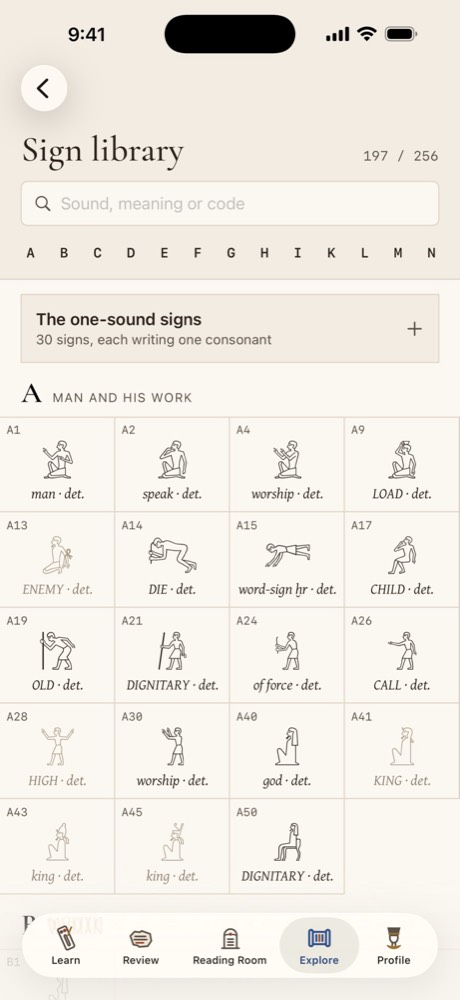
The Sign library in Sesh holds all 256 signs of the course, arranged in Gardiner’s groups from A to Aa, with the code on every tile. Signs you have learned are drawn in ink; the rest are pale but open, each linked to the lesson that teaches it.
- Search by sound, by meaning or by code: type G17 and the owl comes up.
- A table of the one-sound signs, in dictionary order.
- Find a sign by shape: draw it roughly, and Sesh suggests the signs it could be.
iPhone and iPad · iOS 17 or later
References
- Gardiner, Alan H. Egyptian Grammar: Being an Introduction to the Study of Hieroglyphs. 3rd edition, revised. Oxford: Griffith Institute, Ashmolean Museum, 1957.
- Allen, James P. Middle Egyptian: An Introduction to the Language and Culture of Hieroglyphs. 3rd edition. Cambridge: Cambridge University Press, 2014.
- Collier, Mark, and Bill Manley. How to Read Egyptian Hieroglyphs: A Step-by-Step Guide to Teach Yourself. Revised edition. London: British Museum Press, 1998.
- Manley, Bill. Egyptian Hieroglyphs for Complete Beginners. London: Thames & Hudson, 2012.
- Grimal, Nicolas, Jochen Hallof, and Dirk van der Plas, eds. Hieroglyphica: Sign List / Liste des signes / Zeichenliste. Publications Interuniversitaires de Recherches Égyptologiques Informatisées 1. 2nd edition. Utrecht and Paris: Centre for Computer-aided Egyptological Research, 2000.
- The Unicode Consortium. The Unicode Standard, Version 16.0, “Egyptian Hieroglyphs” (blocks U+13000–U+1345F and U+13460–U+143FF). 2024.
- Sesh: Learn Hieroglyphs (iOS app), course, Reading Room and sign library content, version of November 2026. Each lesson card names its source in the works above. Sign library: signs.json, 256 signs with Gardiner code, value and source.
Sesh app content cited as “Sesh, lesson L…” or “Sesh Reading Room” is the app’s own teaching text, itself sourced to the works above. Photos are credited under each image. Not affiliated with the museums shown.