

 Türkçe
 Deutsch
 Français
Signs that write a language
Hieroglyphs are the signs of ancient Egypt's monumental script. They were carved on temple walls and stelae, painted in tombs and on coffins, and even worked in gold and inlay on jewellery. Above all, they write a real language: Egyptian.
It helps to keep two things apart from the start. Egyptian is a language, spoken for thousands of years. Hieroglyphs are one way of writing it, much as the Latin alphabet is one way of writing English. Learning to read hieroglyphs therefore means learning two things at once: the script, and step by step the language behind it.
Hieroglyphs were not the only Egyptian script. For everyday writing, scribes used hieratic, a fast cursive form of the same signs written in ink. Much later came demotic, a still more cursive script; the word also names a late stage of the language. The script itself was used for more than three thousand years: the last dated hieroglyphic inscription was carved at Philae in AD 394.
The word “hieroglyph” comes from Greek and means “sacred carving”. In this guide, a hieroglyph is a single sign, hieroglyphic describes the script, and Middle Egyptian is the language you will read.
One language, five stages
Egyptian changed over more than three thousand years, as every language does. Egyptologists divide its history into five stages: Old Egyptian, Middle Egyptian, Late Egyptian, Demotic and Coptic.
| Stage | Roughly when | Written in |
|---|---|---|
| Old Egyptian | Old Kingdom | hieroglyphs, hieratic |
| Middle Egyptian | Middle Kingdom; kept afterwards as the classical language | hieroglyphs, hieratic |
| Late Egyptian | New Kingdom and after | hieratic, hieroglyphs |
| Demotic | Late Period to Roman times | the demotic script |
| Coptic | Roman period and after | an alphabet based on Greek letters |
“Hieroglyphic” is a script; “Middle Egyptian” is a language. The two overlap but are not the same. Hieroglyphs wrote Old, Middle and later Egyptian; Middle Egyptian could be written in hieroglyphs or in hieratic; and Coptic, the last stage, was not written in hieroglyphs at all. The Rosetta Stone shows the difference neatly: one decree, carved in hieroglyphs, demotic and Greek.
Why begin with Middle Egyptian? It is the classical stage of the language: the Egyptian of Middle Kingdom stelae and of classic literature such as the Story of Sinuhe, and later scribes kept writing it on monuments long after everyday speech had moved on. The standard teaching grammars, Gardiner's Egyptian Grammar and Allen's Middle Egyptian, both teach it, so it is where nearly every student starts. Royal names from earlier periods, such as Khufu's and Pepi's, are written the same way, so you can read them too.
The stages are a scholarly division of a continuous history, and the dates given for them differ from book to book. The written language also changed more slowly than speech, so a text's stage and its date do not always match. Allen's introduction is a good short account.
Every sign is a picture. Not every picture means what it shows.
Each hieroglyph depicts something: a person, an animal, a plant, a building, a tool. What it does in a word is another matter.
Egyptologists refer to signs by their number in the sign list of Sir Alan Gardiner's Egyptian Grammar. Gardiner sorted the signs by what they show into lettered groups, from A (man and his occupations) to Aa (unclassified), and numbered them within each group. So A1 is the seated man, G17 the owl, N35 the ripple of water. These “Gardiner numbers” are the common reference system in grammars, dictionaries and sign lists.
A sign can do one of three main jobs:
- Sound-sign (phonogram): it writes one, two or three consonants, whatever the picture shows. The owl 𓅓 writes m.
- Word-sign (logogram or ideogram): it writes a whole word, usually the thing it shows. The plan of a house 𓉐 with a stroke writes pr, “house”.
- Determinative: it is silent, and shows what kind of word you are reading. The seated man 𓀀 after a name says “this is a man”.
A fourth, smaller job is the phonetic complement: a sound-sign that repeats part of a bigger sign's value as a reading aid (section 07). The same sign can do different jobs in different words, which is why the jobs, not the pictures, are what you learn.
The “alphabet” is only the beginning
There are about two dozen signs that each write a single consonant: Gardiner’s alphabet table (p. 27) has 24 entries, Allen’s (§2.3) has 25, because Allen keeps the door bolt (z) apart from the folded cloth (s), two sounds that had merged by the Middle Kingdom. Popular books call them the hieroglyphic alphabet, and they are the right place to start. But Egyptian never used them on their own, the way English uses its letters.
Scribes mixed one-consonant signs with two- and three-consonant signs, word-signs and silent determinatives, all in the same word. No sign writes more than three consonants. A sound-sign is like a letter in one way: it can come back as often as a word needs it. In Khufu's name, ḫwfw, the quail chick appears twice, once for each w.
Two more things set the script apart from an alphabet. It writes consonants only: the vowels were spoken but not written, so we know the skeleton of a word much better than its sound. And spelling was flexible: the same word could be written in more than one accepted way.
There is one place where Egyptian does come close to an alphabet: foreign names. Greek names such as Ptolemy and Cleopatra had no meaning in Egyptian, so scribes spelled them purely with sound-signs. That is exactly why Champollion's decipherment began with them. The name Ptolemy, known from the Greek on the Rosetta Stone, gave the first sound values, and Cleopatra's cartouche let him check them sign by sign.
One, two or three consonants
Sound-signs are called uniliteral, biliteral or triliteral, after the number of consonants they write. Learn the uniliterals first: you will meet them in almost every line.
The one-consonant signs (uniliterals)
The table follows the conventional order of the Egyptological alphabet, the order used in dictionaries. The “Said as” column gives the modern classroom convention for pronouncing each consonant, not a reconstruction of the ancient sound (see the Note below and section 11).
| Sign | Gardiner | Translit. | Said as | What it shows |
|---|---|---|---|---|
| 𓄿 | G1 | ꜣ | “a”: a consonant, the aleph | Egyptian vulture |
| 𓇋 | M17 | ỉ | “i”: a weak consonant | flowering reed |
| 𓇋𓇋 𓏭 | M17 ×2 · Z4 | y | “y” | two reeds; two strokes |
| 𓂝 | D36 | ꜥ | “a”: a deep throat sound absent from English | forearm, palm up |
| 𓅱 𓏲 | G43 · Z7 | w | “w”, or “u” between consonants | quail chick; its cursive curl |
| 𓃀 | D58 | b | b | lower leg and foot |
| 𓊪 | Q3 | p | p | stool |
| 𓆑 | I9 | f | f | horned viper |
| 𓅓 | G17 | m | m | owl |
| 𓈖 | N35 | n | n | ripple of water |
| 𓂋 | D21 | r | r | mouth |
| 𓉔 | O4 | h | h, as in “house” | reed shelter |
| 𓎛 | V28 | ḥ | h: a stronger, breathy h | wick of twisted flax |
| 𓐍 | Aa1 | ḫ | “kh”, like ch in Scottish “loch” | uncertain; Gardiner: perhaps a placenta |
| 𓄡 | F32 | ẖ | “kh”, softer, perhaps like German “ich” | animal's belly with udder |
| 𓊃 | O34 | s (z) | s; originally a separate sound, z | door bolt |
| 𓋴 | S29 | s | s | folded cloth |
| 𓈙 | N37 | š | “sh” | pool |
| 𓈎 | N29 | q | q: a k made far back in the throat | sandy hill-slope |
| 𓎡 | V31 | k | k | basket with a handle |
| 𓎼 | W11 | g | g, as in “go” | jar stand |
| 𓏏 | X1 | t | t | loaf of bread |
| 𓍿 | V13 | ṯ | “tch” | tethering rope |
| 𓂧 | D46 | d | d | hand |
| 𓆓 | I10 | ḏ | “dj”, like j in “jet” | cobra |
Two details matter at once. Two reeds side by side are not “ỉ twice” but one sound, y: Pepi's name 𓊪𓊪𓇋𓇋 reads p-p-y. And Egyptian had four different h-sounds, kept apart in transliteration with small marks, because they change the word: ḥr is “Horus”, ḫr “with, near”, ẖr “under”. You will also meet variants, such as the red crown 𓋔 (S3) for n from early Dynasty 12, and a less common m-sign 𓐝 (Aa15).
Several identifications are uncertain. Nobody is sure what 𓐍 (Aa1) shows: Gardiner suggested a placenta with a question mark, Allen leaves it open, and Manley describes a ball of twine. Its sound, ḫ, is certain. The ancient pronunciation of several consonants, above all ꜣ, ỉ and ꜥ, is reconstructed rather than known; the “said as” values are a teaching convention.
Two-consonant signs (biliterals)
Many signs write two consonants at once. Their values often come from the word the picture shows: the mouth 𓂋 is r because the Egyptian word for “mouth” was r, and the forearm 𓂝 is ꜥ from ꜥ, “arm”. The same idea, a picture borrowed for its sound, gives the two- and three-consonant signs.
Three-consonant signs (triliterals)
A smaller group of signs write three consonants. Most are tied to one word or word family, and they often bring one or two small helper signs with them.
When a picture is the word
A word-sign (logogram, often called an ideogram) writes a whole word, usually the thing it depicts. A large sign with several consonants often does this by itself: the ankh alone is the word ꜥnḫ.
Scribes had a simple flag for this job: a short vertical stroke, 𓏤 (Gardiner Z1), written under or beside the sign. It says “read the sign above as the thing it shows”. The sun with a stroke is the word rꜥ, “sun”; the house plan with a stroke is pr, “house”.
Do not confuse the single stroke with its relatives. Three strokes 𓏥 (Z2) after a word mark the plural, and two strokes 𓏭 (Z4) can mark a pair or write the sound y. Context tells you which.
Helper signs you read once
Two- and three-consonant signs often come with one-consonant signs that repeat part of their value. These phonetic complements make the reading sure. You pronounce the sound once.
Complements usually follow the bigger sign, and some sit before it or around it. They are one reason Egyptian spellings look longer than the words they write. They are also a gift to beginners: if you have forgotten a biliteral, the complement often gives half of it back.
Silent signs that sort words
A determinative is a sign at the end of a word that is not pronounced and not transliterated. It tells you what class of thing the word belongs to: a man, a woman, a god, a town, an abstract idea.
Because Egyptian was written without spaces, determinatives do a second job: they show where a word stops. A word may have no determinative, one, or several. Some scholars prefer the term classifier, which describes the same signs.
| Det. | Gardiner | Class | Example | Translit. |
|---|---|---|---|---|
| 𓀀 | A1 | man, person | 𓌢𓈖𓀀 | sn |
| 𓁐 | B1 | woman | 𓈞𓏏𓁐 | ḥmt |
| 𓀭 | A40 | god (also king) | 𓊹𓀭 | nṯr |
| 𓊖 | O49 | town, place | 𓆎𓏏𓊖 | Kmt |
| 𓏛 | Y1 | writing, abstract | 𓂋𓐍𓏛 | rḫ |
Determinatives can change how you understand a whole name. The crocodile god Sobek is spelled s-b-k and ends with a crocodile on a shrine. A name built on Sobek is something else: inside a cartouche it belongs to a king; with the seated man 𓀀 after it, it is a private man. The silent last sign tells you who you are reading about.
The determinatives a word takes vary between objects and periods. Gardiner's writing of Cleopatra ends with the loaf and the egg 𓆇; other writings add a seated woman as well. Learn the common classes, then let each object show you its own spelling.
Read towards the faces
Hieroglyphs can run from right to left or from left to right, in horizontal lines or in vertical columns. The signs themselves tell you which.
Signs that have a front, such as people, animals and birds, face the beginning of the line. If the birds face right, start reading on the right; if they face left, start on the left. Columns are read from top to bottom, and within a line an upper sign is read before the one below it. A sign that faces the other way is still the same sign: scribes flipped signs freely to suit the direction of the text.
Egyptian scribes favoured right to left. Modern books usually print hieroglyphs left to right because it is easier to typeset; neither is wrong. On monuments, a short caption beside a figure faces the same way as that figure, and craftsmen sometimes carved a phrase twice, facing outwards from a centre line, for symmetry.
Honorific transposition: gods and kings go first
One habit breaks the rule of reading in order. Out of respect, the name of a god, or a word for the king, is often written before the words it follows in speech. Egyptologists call this honorific transposition. We transliterate in spoken order and join the parts with hyphens.
Partly from foreign scripts that write vowels. Scribes abroad wrote Ramesses' names in cuneiform, and the birth name comes out roughly as ria-masi-sa maya-mana: Ra first, but “beloved” before Amun. For many names, though, the spoken order is an inference, and books sometimes differ.
Signs live in invisible squares
Scribes did not string signs along a line like letters. They grouped them into imaginary squares, called quadrats, so that the writing had no ugly gaps.
Shape decides the grouping. Flat signs, such as the loaf, the stool and the viper, are stacked. Tall signs, such as the reed and the chick, stand side by side. Tiny signs are tucked into empty corners. Read the top of a block before the bottom; when signs sit side by side, start on the side the faces look towards.
So how do you find where one word ends and the next begins? Three clues work together: determinatives close many words; certain groups recur so often that you recognise them whole, like sꜣ rꜥ “Son of Ra” or the opening of the offering formula; and the more vocabulary you know, the more the line divides itself.
Writing Egyptian in Latin letters
Transliteration renders each Egyptian consonant with one Latin letter or special symbol. It records exactly the consonants the scribe wrote, so a word can be quoted, sorted and looked up in a dictionary.
Determinatives are not transliterated, and transliteration always runs left to right. It is printed in italics, and Egyptologists separate grammatical parts with marks: a hyphen in compound names (twt-ꜥnḫ-ỉmn), “=” before a suffix pronoun (sꜣ=f, “his son”), a dot before an ending (sḏm.n=f, “he heard”). Older books write the suffix with a dot too: sḏm.f.
| Symbol | Also written | Said as | Example |
|---|---|---|---|
| ꜣ | 3 (when typing) | “a” | sꜣ son |
| ỉ | j (Allen); i̓ | “i” | ỉmn Amun |
| y | – | “y” | ppy Pepi |
| ꜥ | ayin | “a” | ꜥnḫ life |
| w | – | “w” or “u” | ḫwfw Khufu |
| b | – | b | sbk Sobek |
| p | – | p | ptḥ Ptah |
| f | – | f | sꜣ=f his son |
| m | – | m | mn enduring |
| n | – | n | nfr good |
| r | – | r | rꜥ Ra, sun |
| h | – | h | hꜣw affairs |
| ḥ | – | h | ḥtp offering |
| ḫ | – | kh | ḫpr come into being |
| ẖ | h̲ | kh | ẖr under |
| s | z (Allen, for 𓊃) | s | sn brother |
| š | – | sh | šnw cartouche |
| q | ḳ (Gardiner, Faulkner) | q / k | qbḥ cool water |
| k | – | k | kꜣ ka |
| g | – | g | gbb Geb |
| t | – | t | twt image |
| ṯ | tj | tch | mnṯw Montu |
| d | – | d | dỉ give |
| ḏ | dj | dj | ḏt eternity |
Because vowels were not written, Egyptologists slip a short e between consonants so that words can be said aloud, and say ꜣ and ꜥ as “a”, ỉ as “i” and w as “u”: nfr becomes “nefer”, ḥtp “hetep”, ppy “Pepy”, sbk-ḥtp “Sobekhotep”. This is an agreed habit for talking about Egyptian, not how the Egyptians spoke. Where real vowels survive, as in Coptic, they are often different: the god ỉmn is “Amoun” in Coptic.
Conventions differ between books, so check which one your book uses. Sesh writes ỉ for the reed, close to Gardiner's i̓; Allen writes j. Allen keeps z apart from s, while many books write s for both, since the two sounds had merged by the Middle Kingdom. Sesh writes nsw for “king”, as Gardiner, Faulkner and Collier & Manley do; Allen writes nswt. Same Egyptian, different spellings of it.
Signs give you words. Grammar gives you sentences.
You can spell out a royal name with signs alone. To read a sentence, you need a little grammar. These five patterns cover a surprising share of what beginners meet on stelae.
1 · The verb comes first
In a typical Egyptian verb clause the verb comes first, then the doer, then the rest. Little words go before big ones: a pronoun subject or object can jump ahead of a noun.
2 · Nouns: gender and number
Every noun is masculine or feminine. Feminine nouns usually end in -t, the loaf 𓏏: sꜣ “son”, sꜣt “daughter”. The plural is usually shown with three strokes 𓏥, the dual (“two of”) with two strokes or a doubled sign: tꜣwy, “the Two Lands”, is Egypt's own name for Upper and Lower Egypt.
3 · The adjective follows, and the owner follows too
Egyptian puts the describing word after its noun and makes it agree: nṯr nfr, “the good god”. Two nouns side by side make a possessive, with no word for “of”: sꜣ rꜥ, “son of Ra”; nb tꜣwy, “lord of the Two Lands”. Grammars call this the direct genitive.
4 · Pronouns glued to the end
“His son” is son + his: sꜣ=f 𓅭𓆑. These suffix pronouns attach to the word before them, whether a noun, a preposition or a verb, and they are spelled with signs you already know.
| Suffix | Meaning | Suffix | Meaning |
|---|---|---|---|
| =ỉ | I, me, my | =n | we, us, our |
| =k | you, your (m.) | =ṯn | you, your (pl.) |
| =ṯ | you, your (f.) | =sn | they, them, their |
| =f | he, him, his | =s | she, her |
5 · A first look at the verb: sḏm=f
Grammars name verb forms after the model verb sḏm, “hear”. The plain form sḏm=f is the verb stem with a suffix subject, “he hears”; it leaves tense and mood to the context, so it can state a habit, a wish or a future. Add n and you get sḏm.n=f, 𓄔𓅓𓈖𓆑, “he heard”, which reports a completed action. That is all you need for now: the full verb system is the heart of a Middle Egyptian course.
Gardiner, Allen and Collier & Manley analyse the verb forms in different ways and give them different names. Gardiner separates forms of sḏm=f by whether the verb stem doubles; Allen counts one active sḏm=f. Both are valid descriptions of the same texts, which is why grammars can look inconsistent when you compare them.
A stela, step by step
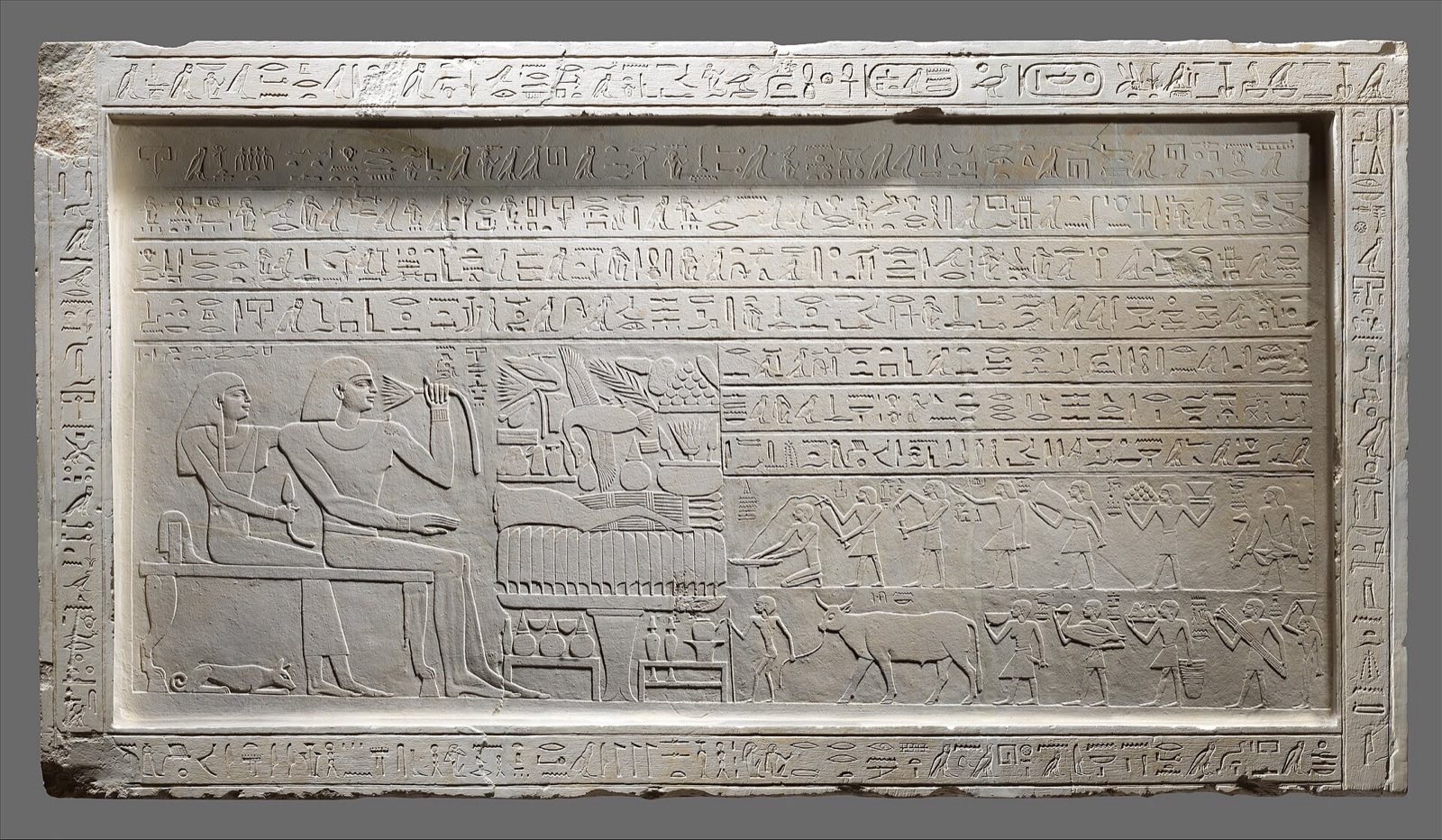
Here is the most common inscription in Egypt, the offering formula, as it opens the top line of a Middle Kingdom stela in New York. You can read it with what you have learned above.
-
1Find the start
The text begins at the right end of the top line, so its signs face right. Read from right to left, top before bottom inside each block.
-
2Spot the fixed group𓇓nswM23king𓊵ḥtpR4offering𓏙dỉX8give
Sedge, loaf on a mat, conical loaf: written king, offering, give, but read ḥtp-dỉ-nsw. Two habits meet in three signs: abbreviation (the sedge alone stands for nsw, “king”) and honorific transposition (the king is written first but read last).
-
3Name the god𓊨𓁹wsỉrQ1 · D4Osiris
Seat over eye spells the name of Osiris, a group you learn as a whole: nobody knows why these two signs were chosen.
-
4Read the epithet𓎟nbV30lord𓊽𓊽ḏdwR11 ×2Busiris𓊖(silent)O49town det.
The basket nb in front of a noun means “lord of”. Two djed pillars and the town determinative spell ḏdw, Busiris, a Delta town of Osiris. The town sign is not pronounced. nb ḏdw is a direct genitive: “lord (of) Busiris”.
-
5Put it together, then know what follows
Literal: “offering (which) the king gives (to) Osiris, lord (of) Busiris”. In natural English: “An offering which the king gives to Osiris, lord of Busiris.” On Middle Kingdom stelae the formula usually has four parts: the king's offering; the god or gods who receive it, with their epithets; the gifts passed on to the dead, introduced by dỉ=f, “that he may give”; and the person who benefits, “for the ka of” the owner.
Gardiner and Faulkner translate the opening “a boon which the king gives”, Allen “a royal offering”, and Collier & Manley note that the phrase came to be treated as a fixed compound. Scholars also read dỉ=f differently: Gardiner and Collier & Manley take it as purpose, “so that he may give”; Allen reads it as a clause describing the god, “giving”. Some scholars read the god's name jsjr rather than wsỉr.
From signs to sentences
Every course orders things a little differently, but the route from first sign to real texts has a natural shape. Each step lets you read something new on real objects.
- 1The one-consonant signs and reading directionYou can read: royal names spelled with sounds, such as ḫwfw Khufu and ppy Pepi, in either direction.
- 2Two- and three-consonant signs, complements, word-signsYou can read: names like ỉmn-ḥtp Amenhotep and s-n-wsrt Senwosret, and the wish dỉ ꜥnḫ, “given life”.
- 3Determinatives and the noun phraseYou can read: titles such as nsw-bỉty, sꜣ rꜥ, nb tꜣwy and ḥmt nsw wrt, “Great Royal Wife”.
- 4Fixed formulasYou can read: the offering formula, dates and the names and titles on a whole Middle Kingdom stela.
- 5Sentences: pronouns, prepositions, sḏm.n=f and sḏm=fYou can read: captions, biographies (“I did…”) and appeals to the living on stelae.
- 6The verb system and literatureYou can read: temple texts, the Book of the Dead and the great stories, ending with the Story of Sinuhe.
Two habits make the difference. Learn signs by their jobs and Gardiner numbers, not only their pictures, so you can look them up. And read real objects from the very beginning: a cartouche you can read on a museum photograph teaches more than ten drills.
Five things people get wrong
About two dozen signs write single consonants, but Egyptian combined them with two- and three-consonant signs, word-signs and determinatives in the same words. The “alphabet” is a teaching tool, not how the script worked.
In most words, many signs are used for their sound, not their picture. The owl 𓅓 writes m, the mouth 𓂋 writes r, the duck 𓅭 writes sꜣ “son”. Only some signs work as word-signs, and the same sign can switch jobs.
They can run either way, or in columns. You read towards the faces of the signs, and Egyptian scribes actually preferred right to left. Left-to-right is mostly a habit of modern printing.
A converter that swaps modern letters for one-consonant signs is fun for writing a name, and the result is a modern sound-based approximation, not an ancient word. Reading a real inscription is different: it needs Egyptian vocabulary, spelling habits such as transposition and abbreviation, and grammar, as the stela in section 13 shows.
Vowels were not written. The familiar “e” in nefer or hetep is a modern convention. Coptic and foreign writings of Egyptian names give real clues to the sounds, but much of the pronunciation is reconstructed and still debated.
Where to go next
Four books carry most learners from beginner to independent reader. They are also the books every rule in Sesh cites.
Online
- The Griffith Institute, University of Oxford: the publisher of Gardiner's Grammar and Faulkner's Dictionary, and home of major Egyptological archives.
- The Metropolitan Museum of Art, collection online: object records with museum numbers, including both stelae on this page (57.95 and 12.182.1); many images are Open Access.
- The British Museum, collection online: the Rosetta Stone (EA 24) and many stelae and papyri.
- The Louvre, collections database: the Louvre's Egyptian antiquities, object by object.
Practise on these collections the way this guide did: find a cartouche or an offering formula, decide where the line starts, and read the signs you know.
- Gardiner, Alan H. Egyptian Grammar: Being an Introduction to the Study of Hieroglyphs. 3rd ed., revised. Oxford: Griffith Institute, 1957.
- Allen, James P. Middle Egyptian: An Introduction to the Language and Culture of Hieroglyphs. 3rd ed. Cambridge: Cambridge University Press, 2014.
- Faulkner, Raymond O. A Concise Dictionary of Middle Egyptian. Oxford: Griffith Institute, 1962.
- Collier, Mark, and Bill Manley. How to Read Egyptian Hieroglyphs. London: British Museum Press, 1998.
- Manley, Bill. Egyptian Hieroglyphs for Complete Beginners. London: Thames & Hudson, 2012.
- Leprohon, Ronald J. The Great Name: Ancient Egyptian Royal Titulary. Atlanta: Society of Biblical Literature, 2013.
- The Metropolitan Museum of Art, New York. Stela of Rehuerdjersen, 12.182.1. Middle Kingdom, 12th Dynasty.
- The Metropolitan Museum of Art, New York. Stela of the Overseer of the Fortress Intef, 57.95. Middle Kingdom, early 12th Dynasty.
- The British Museum, London. The Rosetta Stone, EA 24. Ptolemaic, decree of 196 BC.
Sign numbers follow Gardiner's sign list. Transliteration follows the conventions of the Sesh app (ỉ for the reed, s for both s-signs, nsw for “king”). Faulkner is cited by headword (s.v.). Found a mistake? Write to support@hieroglyphs.app.