
 Türkçe
 Deutsch
 Français
The Story of Sinuhe
The Story of Sinuhe is a literary tale of the Middle Kingdom, composed early in the 12th Dynasty and copied for centuries. It tells of an official who flees Egypt when King Amenemhat I dies, builds a new life in the Levant and comes home in old age to be buried in Egypt. Egyptologists treat it as the classic of Middle Egyptian literature, and with the grammar in hand you can read it in the original.
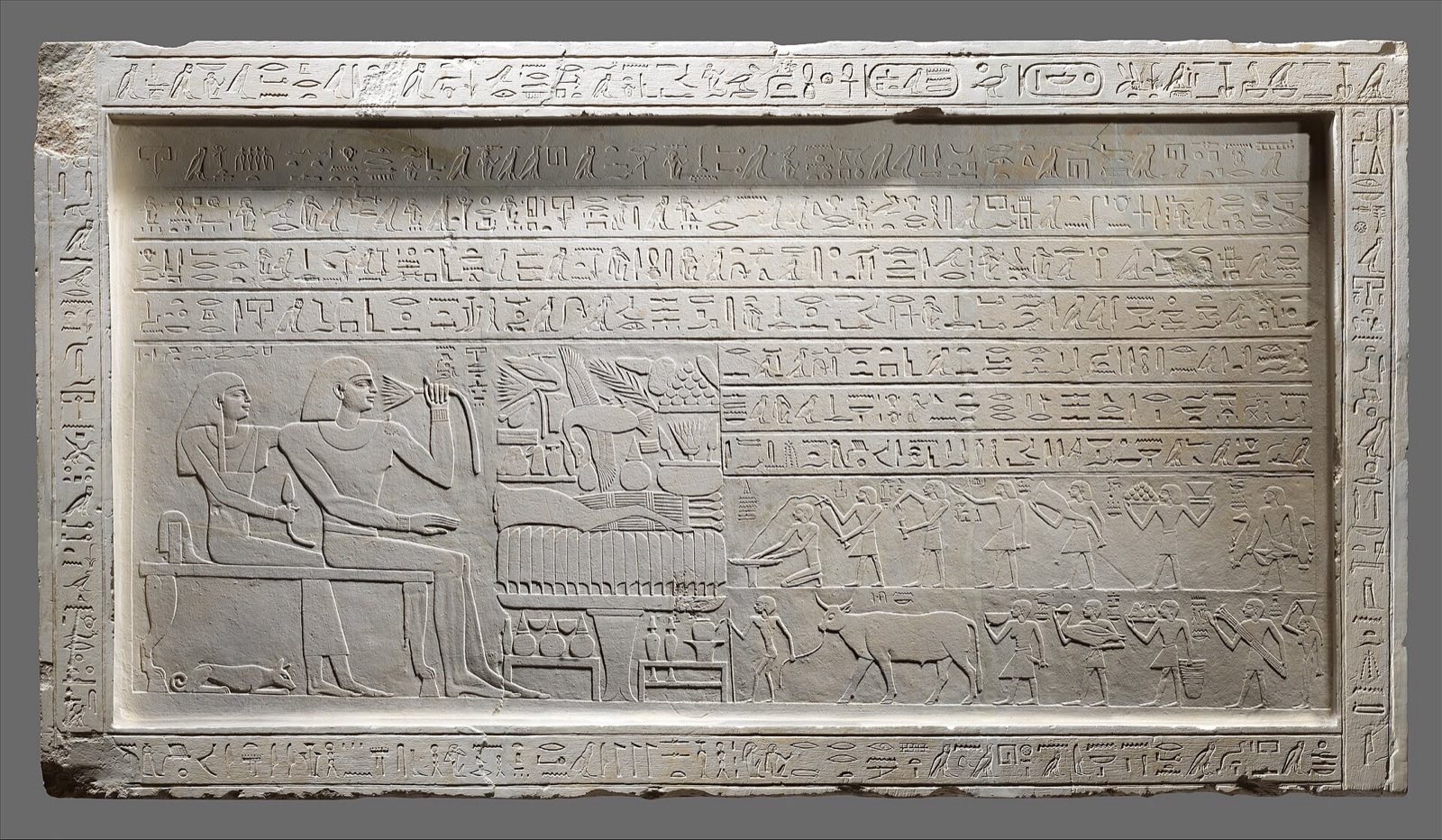
Of all the texts written in Middle Egyptian, one has been read, copied and loved more than any other: the story of Sinuhe, a courtier who runs from Egypt, makes a life abroad and longs to come home. For a student of hieroglyphs it is the summit, and a realistic one.
This guide explains what the text is, how it survives and what you need to read it in the original. If you are just starting with the script itself, the cornerstone guide is How to read Egyptian hieroglyphs.
01What the text is
The Story of Sinuhe is a literary tale of the Middle Kingdom. It was composed early in the 12th Dynasty and copied until the Ramesside period, partly by schoolboys learning to write. It is set under King Senwosret I and told as if it were the biography carved in Sinuhe’s own tomb: it opens with his titles, his name and the words “he says”. Much of it is written in what Allen calls thought couplets, pairs of clauses in which the second repeats or extends the first, so that it reads almost like poetry (Allen, Essay 18 p. 285 and Essay 20 p. 327).
The hero’s name, sꜣ-nht, means “son of the sycamore”.
02The manuscripts
No single copy preserves the whole story. Two papyri carry most of it, and later copies, such as the large ostracon in Oxford, fill gaps and offer variant wordings. Scholars cite lines by manuscript and line number, such as Sin. R 6 or Sin. B 20 (Gardiner p. xxviii; Allen p. 553).
| Siglum | Manuscript | What it is | Preserves |
|---|---|---|---|
| B | Papyrus Berlin 3022 Ägyptisches Museum und Papyrussammlung, Berlin | Middle Kingdom, 12th Dynasty. Hieratic in ink: columns at the start, then horizontal lines, with a heading in red. One of the main copies. | most of the story |
| R | The Ramesseum papyrus Papyrus Berlin 10499 | Found at the Ramesseum, Thebes. Late 12th or 13th Dynasty. A long roll with the Eloquent Peasant on one side and Sinuhe on the other. | the opening, missing in B |
| AO | The Ashmolean ostracon Ashmolean Museum, Oxford | A large flake of limestone, one of the best-known of the copies made by student scribes. Published by Barns in 1952. | a long stretch of the story |
The papyri are written in hieratic, the fast hand of everyday writing, not in hieroglyphs. Like every student of the text, you read Sinuhe in a hieroglyphic transcription: Egyptologists first set the hieratic signs in hieroglyphs, then translate.
03Why it is the classic of Middle Egyptian literature
Allen and Gardiner both treat Sinuhe as a classic of Middle Egyptian literature, and its lines are quoted throughout their grammars. Several reasons stand out:
- It was a classic in Egypt too. It was copied for centuries after it was written, and student scribes learned their craft on it.
- It holds many kinds of writing in one text. A tomb biography frames the whole; inside it are a dialogue, a hymn of praise to the king, an account of a duel, a royal decree quoted in full and a courtier’s formal reply.
- Its language is the classical standard. Grammars use its sentences as model examples of the verb forms, clauses and royal speech of Middle Egyptian.
- It still speaks to readers. Exile, success abroad, homesickness and the wish to be buried at home are easy to recognise. Allen notes that the duel foreshadows the story of David and Goliath, and the long exile recalls Moses: parallels of motif, not borrowing, since the Egyptian story is far older (Allen, Essay 20 p. 327).
04What happens in the story
In outline, following the episodes as Sesh reads them:
- 01King Amenemhat I dies. The palace falls silent.
- 02The army is returning from a campaign in Libya. Messengers ride out to the king’s son. Sinuhe, standing nearby, overhears the news and flees.
- 03He crosses the river in a boat without a rudder, slips past the frontier fortress called the Walls of the Ruler by night, and nearly dies of thirst in the desert, until he hears cattle.
- 04A ruler of Upper Retjenu, in the region of Lebanon, takes him in and asks why he has come. Sinuhe answers with a hymn in praise of the new king, Senwosret I.
- 05He marries the ruler’s eldest daughter, receives a land called Yaa, rich in figs and grapes, and grows wealthy.
- 06A champion of Retjenu challenges him. Sinuhe spends the night preparing his bow and wins with a single arrow.
- 07Old now, he longs to be buried in Egypt. A letter from the king pardons him and promises a proper burial.
- 08He replies in the humble style of a courtier, then returns. He faints before the king, is welcomed by the queen and the royal children, and is given a house and a pyramid of his own.
The story closes as it began, like a tomb inscription, with Sinuhe in royal favour until the day of his death.
05What you need to read it
Sinuhe is not a beginner’s text, but it is not out of reach either. Before you open it you need:
- The signs and a working vocabulary. Sound signs, word signs and determinatives, and the common words of narrative: going, coming, saying, hearing, giving.
- The verb system. The narrative forms sḏm.n=f and sḏm=f, the stative, the story openers ꜥḥꜥ.n and wn.ỉn, speech introduced by ḏd.ỉn=f “then he said”, participles and relative forms, and the noun clauses of royal speech (Allen §14.6, §19.9).
- Non-verbal sentences. Lines such as ỉw ẖnw m sgr “the palace was in silence” have no verb at all.
- How transcriptions work. You will read hieroglyphs set from a hieratic papyrus, with line numbers from the edition.
- Some cultural background. Court titles, foreign places, and why burial in Egypt mattered so much.
06How the Sesh course leads to Sinuhe
Sesh is built so that Sinuhe is reached, not rushed. Each stage adds what the story needs, and the last stage reads it in eleven lessons.
| Stage | Lessons | What it adds |
|---|---|---|
| I · Reader I | L01–L51a | Signs, royal names, gods, dates and the offering formula, up to a whole Middle Kingdom stela. |
| II · Reader II | L52–L107a | Sentences and biographies: captions, “I did…”, appeals to the living. Sinuhe is told as a biography, so this is its home ground. |
| III · Translator | L108w–L161a | The verb system: the stative, sḏm.n=f and sḏm=f, the passive, clauses, participles and relative forms, emphasis and questions. |
| IV · Texts & Literature | L162–L226 | Unit 25, hieratic and how a transcription is made; Unit 28, the Shipwrecked Sailor, your first complete tale; then Unit 29, Sinuhe, lessons 195 to 205. |
Unit 29 · Sinuhe, lesson by lesson
| Lesson | Title | Time | You read |
|---|---|---|---|
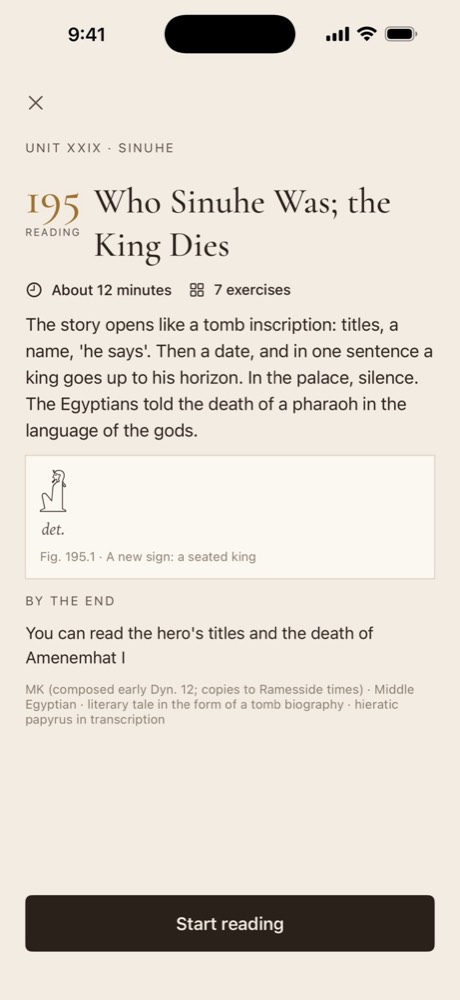
| L195 | Who Sinuhe Was; the King Dies | 12 min | …the hero’s titles and the death of Amenemhat I |
| L196 | Overheard News; Flight | 14 min | …why Sinuhe runs |
| L197 | Thirst in the Desert | 14 min | …the crossing and near death |
| L198 | The Ruler of Retjenu Asks Questions | 14 min | …a dialogue with a foreign ruler |
| L199 | In Praise of the King | 15 min | …a eulogy of Senwosret I |
| L200 | A Life in Retjenu | 14 min | …Sinuhe’s prosperity abroad |
| L201 | The Duel | 15 min | …the fight with the strong man of Retjenu |
| L202 | Longing for Home; the King’s Letter | 15 min | …Sinuhe’s prayer and the royal decree |
| L203 | Sinuhe’s Answer | 13 min | …a courtier’s humble reply |
| L204 | Return to the Palace | 15 min | …the homecoming, the audience, a house and a tomb prepared |
| L205 | “Finished: Sinuhe” | 15 min | …a Sinuhe passage new to you, unaided |
Lessons 195 to 199 draw on the Ramesseum papyrus and Papyrus Berlin 3022; from lesson 200 the text follows Berlin 3022, and lesson 203 opens on the Ashmolean ostracon. Lesson 205 is a passage you have not seen, the warm scene in which the queen and the royal children greet the returning Sinuhe, read on your own. After it comes Unit 30, the Eloquent Peasant.
For the background to the language Sinuhe is written in, read What is Middle Egyptian?
 How Sesh helps
From your first sign to Sinuhe
Sesh takes you there in 231 lessons, about ten minutes a day. You start with the name of Khufu in lesson 1 and finish Stage 4 with the great stories, Sinuhe among them, read line by line in hieroglyphic transcription, with every sign, word and rule explained.
- Each Sinuhe lesson gives the line references, a literal rendering and a natural translation, plus hints that point to the grammar.
- Context cards explain the manuscripts, the thought couplets and the world of the story, each with its source.
- Every stage ends on a text you have never seen, and earns a certificate.
iPhone and iPad · iOS 17 or later
References
- Allen, James P. Middle Egyptian: An Introduction to the Language and Culture of Hieroglyphs. 3rd edition. Cambridge: Cambridge University Press, 2014. Essays 18 and 20; Text References p. 553.
- Gardiner, Alan H. Egyptian Grammar: Being an Introduction to the Study of Hieroglyphs. 3rd edition, revised. Oxford: Griffith Institute, Ashmolean Museum, 1957.
- Faulkner, Raymond O. A Concise Dictionary of Middle Egyptian. Oxford: Griffith Institute, 1962.
- Barns, John W. B. The Ashmolean Ostracon of Sinuhe. London: Oxford University Press, 1952.
- Sesh: Learn Hieroglyphs (iOS app), course, Reading Room and sign library content, version of November 2026. Each lesson card names its source in the works above. Reading Room entries “The Story of Sinuhe (Papyrus Berlin 3022)” and “The Eloquent Peasant (Papyrus Berlin 10499)”; Unit 29, lessons L195–L205.
Sesh app content cited as “Sesh, lesson L…” or “Sesh Reading Room” is the app’s own teaching text, itself sourced to the works above. Photos are credited under each image. Not affiliated with the museums shown.