
 Türkçe
 Deutsch
 Français
How to read an Egyptian inscription.
Work in five passes: find which way the signs face, spot the cartouches, look for the offering formula ḥtp-dỉ-nsw, pick out titles and names, then check the silent signs that mark a person or a god. You will not read every word on a first visit, but you will know whose monument it is, which king it names and what it asks for.
You do not need to read every sign to understand an inscription. Five passes, in this order, will tell you who the monument belongs to, which king it names and what it asks of the gods.
The method works best on stelae, false doors, coffins and statues, the objects that fill Egyptian galleries. It assumes you know a handful of signs; if you know none yet, start with How to read Egyptian hieroglyphs.
01Find the direction
Signs with a front, such as people, animals and birds, look towards the beginning of the line. Birds facing left: start on the left. Facing right: start on the right. Columns are read from top to bottom, and within a group the upper sign comes before the lower one. Egyptian scribes preferred right to left, but both directions are normal, and one object can use both.
Short captions beside a figure face the same way as that figure, so the person tells you how to read their own label.
02Spot the cartouches
An oval ring of rope, 𓍷 with a bar at one end, means a king or queen. A king normally had two names in cartouches. The throne name follows the title nsw-bỉty “King of Upper and Lower Egypt”; the birth name follows sꜣ rꜥ “Son of Ra”. Find those titles and you know which cartouche is which, and the king’s name dates the object. The ring itself is silent. More on the five royal names in The Egyptian cartouche.
03Find the offering formula
On Middle Kingdom stelae and coffins, the text you will meet most often is the offering formula. Its first group is easy to spot once you know it: the sedge plant, the bread loaf on a mat and the triangular loaf.
Almost every example follows the same four parts, so once you have found part 1, you know what comes next.
| Part | Typical words | Meaning |
|---|---|---|
| 1 · The opening | 𓇓𓏏𓊵𓏙 ḥtp-dỉ-nsw | “An offering which the king gives”. Written king first, out of respect, and read last. |
| 2 · The god | wsỉr nb ḏdw ỉnpw tpy-ḏw=f | Usually Osiris or Anubis, with epithets: “Osiris, lord of Busiris”; “Anubis, who is on his mountain”. |
| 3 · The request | 𓉓 dỉ=f prt-ḫrw | “so that he may give an invocation offering”, often listed: bread and beer, cattle and fowl. |
| 4 · The owner | n kꜣ n + name | “for the ka of” the owner, whose name often ends with mꜣꜥ-ḫrw “true of voice” or comes with ỉmꜣḫw “revered”. |
04Titles and names
Egyptians were named with their titles, and titles come before the name. Royal titles are few and repeat constantly; private titles tell you what the owner did. After a private name you will often see mꜣꜥ-ḫrw “true of voice”, which in practice marks the person as dead, and family captions such as sꜣ=f mry=f ỉmny “his beloved son Ameny”, from the stela of Khu.
Names themselves are often short sentences about a god: ỉmn-m-ḥꜣt “Amun is at the front” is the name we write Amenemhat.
05Signs for people and gods
The end of a name usually carries a silent sign that tells you who it belongs to. A seated man after a name means a man, a seated woman a woman. A seated god with a curved beard marks a god, and sometimes a king; a falcon on a standard marks something divine. So the same name can be a god, a king or a private person, and the last sign decides.
These are determinatives, silent signs that classify a word. They have their own guide: Egyptian determinatives, explained.
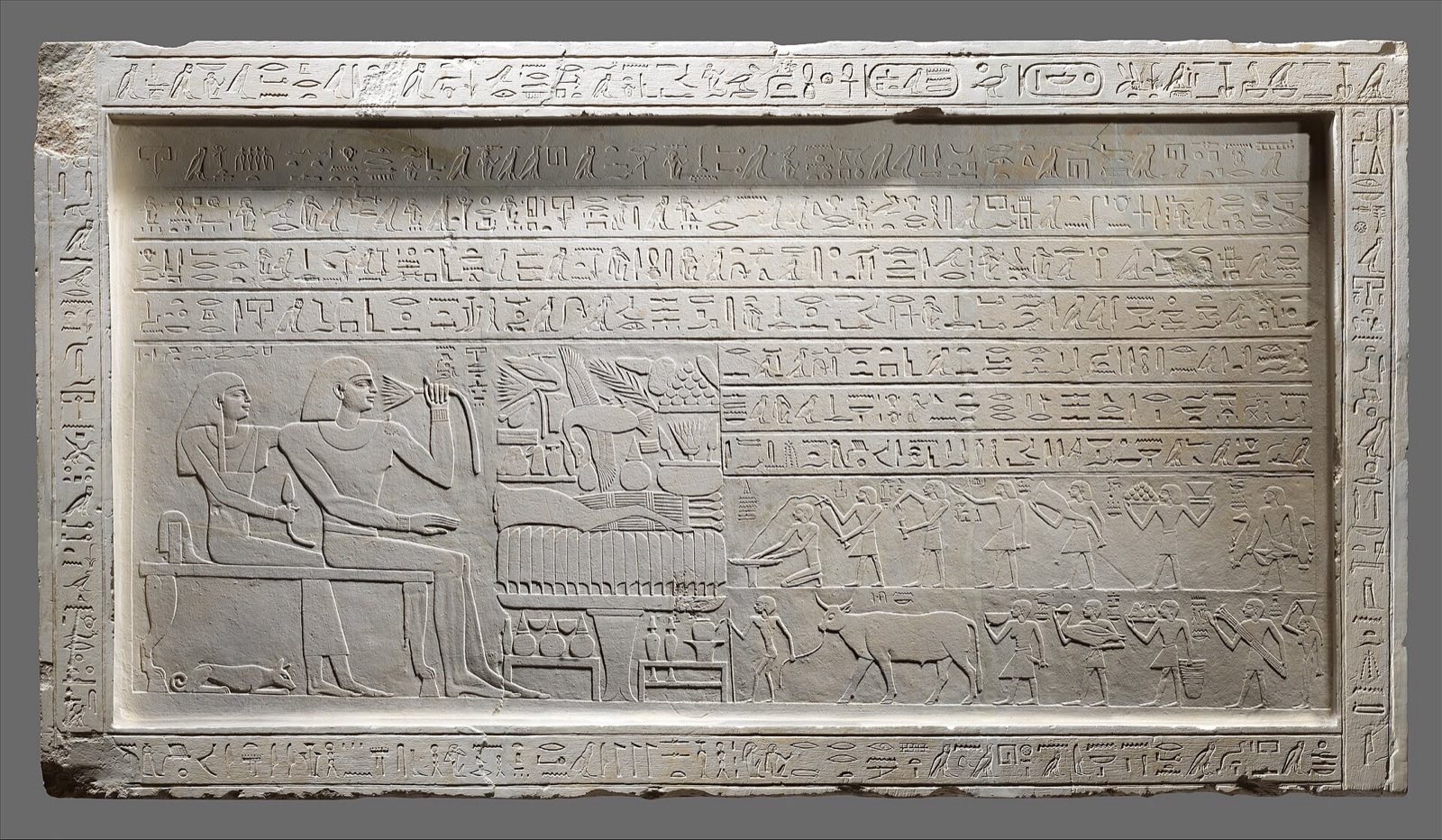
06Walkthrough: the stela of Intef
A soldier’s stela, cut in fine limestone. Try the five passes before reading on.
07Walkthrough: the Merenptah Stela
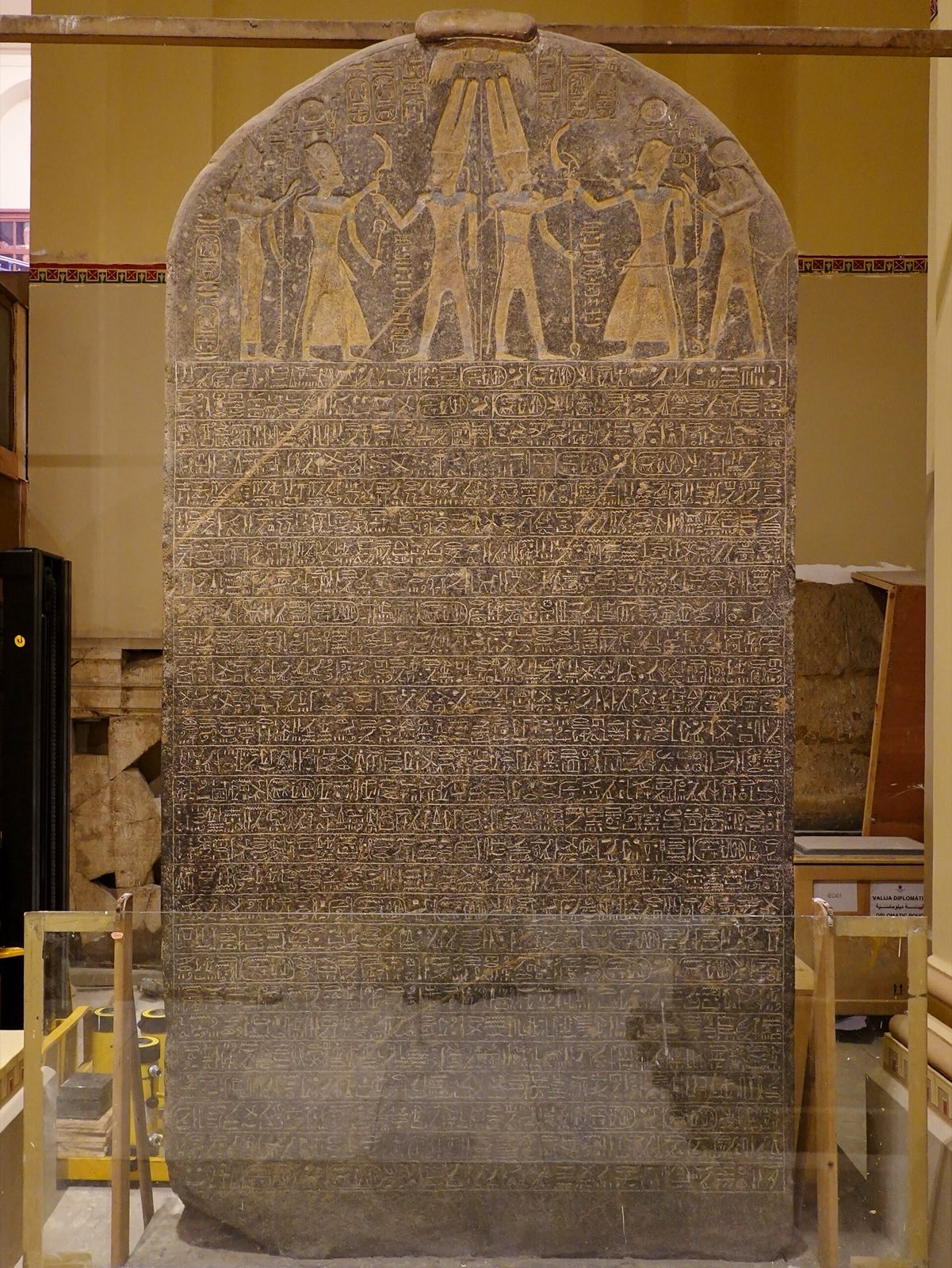
A tall stela on which Merenptah, son of Ramesses II, celebrates his wars. One line of its victory poem holds the oldest name of Israel known anywhere. Here we read just its first line.
Count the cartouches in the top lines: they come in pairs, with a duck between them, again and again. In line 1, just under the scene, the duck faces right, so the line runs from right to left.
Read from the right, the throne name comes first: inside it the sun disk is carved first out of respect but spoken last, bꜣ-n-rꜥ. Then “Son of Ra”, then the second cartouche with the king’s birth name. You have dated the stela to one reign without reading a sentence.
08Where to see inscriptions
Every object on this page is in a public collection, and most museums publish their objects online with photographs. Search the collection site by the inventory number on the label, such as 57.95 at the Met or EA 571 at the British Museum, and you can study the photo at home before or after your visit. Check that the object is on display before you go.
| Museum | Look for | Online |
|---|---|---|
| The Metropolitan Museum of Art New York | Middle Kingdom stelae: Intef (57.95), Rehuerdjersen (12.182.1), Intef and Nesumontu (16.10.327) | metmuseum.org |
| The British Museum London | Stelae of Khu (EA 571), Nakhti (EA 143), Inhuretnakht and Hui (EA 1783) | britishmuseum.org |
| Egyptian Museum Cairo | The Merenptah Stela (JE 31408) | egymonuments.gov.eg |
| Musée du Louvre Paris | Slab stela of Princess Nefertiabet (E 15591) | collections.louvre.fr |
| Museo Egizio Turin | Stela of Padikhonsu (C 1578), hieroglyphs and Demotic on one stone | museoegizio.it |
Galleries of the Middle Kingdom are the best place to practise: their stelae are full of offering formulas, titles and family names, and they repeat the same few patterns again and again.
 How Sesh helps
Read the stela in front of you
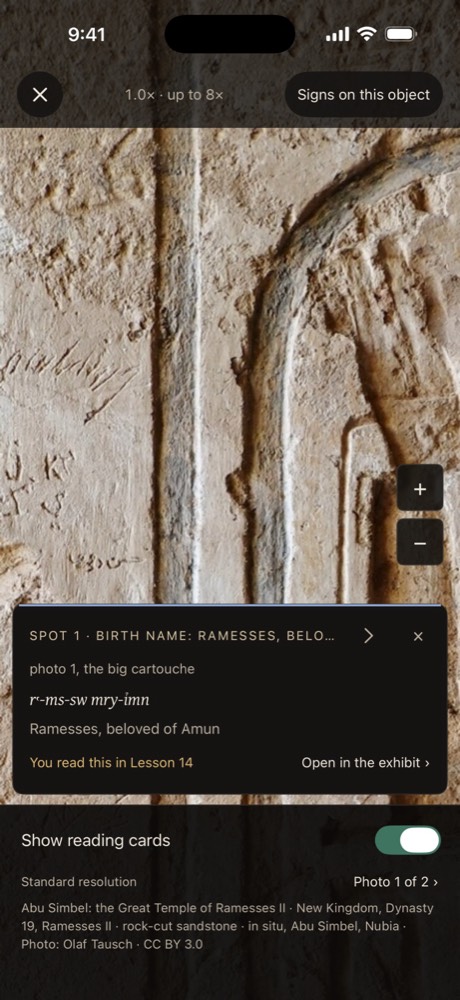
The Reading Room in Sesh holds 132 museum objects, among them the two stelae above. Every marked line is explained sign by sign, then word by word, then in English. New objects unlock as you learn.
- Unit 8 teaches the offering formula part by part; unit 9 adds titles, families and a stela’s layout.
- Museum visit mode groups the objects by museum and works offline in the gallery.
- Reader I, the first of four stages, ends on a whole Middle Kingdom stela you have never seen.
iPhone and iPad · iOS 17 or later
References
- Gardiner, Alan H. Egyptian Grammar: Being an Introduction to the Study of Hieroglyphs. 3rd edition, revised. Oxford: Griffith Institute, Ashmolean Museum, 1957.
- Allen, James P. Middle Egyptian: An Introduction to the Language and Culture of Hieroglyphs. 3rd edition. Cambridge: Cambridge University Press, 2014.
- Collier, Mark, and Bill Manley. How to Read Egyptian Hieroglyphs: A Step-by-Step Guide to Teach Yourself. Revised edition. London: British Museum Press, 1998.
- Manley, Bill. Egyptian Hieroglyphs for Complete Beginners. London: Thames & Hudson, 2012.
- Leprohon, Ronald J. The Great Name: Ancient Egyptian Royal Titulary. Edited by Denise M. Doxey. Writings from the Ancient World 33. Atlanta: Society of Biblical Literature, 2013.
- Sesh: Learn Hieroglyphs (iOS app), course, Reading Room and sign library content, version of November 2026. Each lesson card names its source in the works above. Readings copied from the Reading Room: The Met 57.95; Egyptian Museum, Cairo, JE 31408; British Museum EA 571. Offering formula: grammar topics for lessons 40–47, 102, 128, 147.
Sesh app content cited as “Sesh, lesson L…” or “Sesh Reading Room” is the app’s own teaching text, itself sourced to the works above. Photos are credited under each image. Not affiliated with the museums shown.