
 Türkçe
 Deutsch
 Français
How Egyptian hieroglyphs work.
Hieroglyphs write the ancient Egyptian language with picture-signs that do three jobs: most write sounds (phonograms), some write whole words (logograms), and some are silent and show what kind of word it is (determinatives). Only consonants are written, packed into neat invisible squares that can run in either direction.
I · THE SIGNSThree jobs a sign can do
Every hieroglyph is a picture of something: a quail chick, a hand, the plan of a house, a seated man. But a sign is rarely used for what it shows. In practice each one does one of three jobs, and the same sign can do different jobs in different words.
Phonograms carry most of the load, and they come in three sizes: signs for one, two or three consonants. They have their own guide, Egyptian phonograms. The silent signs are explained in Egyptian determinatives, explained.
II · ONE WORDWatch the jobs work together
Most words mix the jobs. Here is mdw, “words, speech”, exactly as Sesh teaches it, with each sign labelled by what it does.
Read from left to right in this figure: a two-consonant sign gives md; the hand repeats its d as a reading help, so it is not read again; the chick adds w; and the man with his hand to his mouth, a determinative, says that the word has to do with speaking. Together: mdw.
III · SPELLING HABITSHelpers, strokes and plurals
A few spelling conventions turn up on almost every line. Once you know them, most of the small signs that seem to “spoil” a word make sense.
Phonetic complements: read them once
A sign for two or three consonants often brings a small one-consonant sign that repeats part of its sound. It is a reading help, not a new sound. Amun is written reed + game board mn + water n, and read ỉmn, never ỉmnn. The test: does the small sign repeat a sound the big sign already has? If not, it is a new sound, as in nbt “lady”, where the loaf adds a real t.
The stroke: “take this sign as a picture”
A single upright stroke under or beside a sign says: read me as the thing I show. The sun disk with a stroke is rꜥ, “sun” or the god Ra. Spelling was flexible: the same word can also be spelled out with sounds, mouth r + forearm ꜥ, with the sun added as a determinative.
Plural and dual strokes
Egyptian nouns have a singular, a plural and a dual (exactly two). Scribes rarely spelled the endings out. Three strokes, or the sign written three times on older monuments, mean “many”; two strokes, or the sign written twice, mean “two”. The Egyptians called their own country tꜣwy, “the Two Lands”, written with the land sign twice.
IV · LAYOUTBlocks and direction
Egyptian writing has no spaces between words. Instead, scribes packed signs into invisible squares, called quadrats, so that a line looks even. Flat signs, like the stool and the loaf, are stacked; tall ones, like the reed, stand side by side; small ones fill the gaps. Inside a block you read the top before the bottom.
The direction is set by the signs themselves. People, animals and birds face the start of the line: if they look to the right, start on the right. Columns run from top to bottom. Scribes preferred right to left; modern books usually print left to right because it is easier to typeset. Neither is wrong, and the same sign simply turns round.
V · HISTORYFrom Narmer to Philae
Hieroglyphic writing was used for well over three thousand years. A few dates frame the story.
- c. 3100 BCThe Narmer PaletteA king’s name is written as a picture puzzle: a catfish and a chisel that sound like his name, not a portrait of him. Gardiner reproduces it in his account of how writing grew out of the rebus.Egyptian Museum, Cairo, JE 32169; Gardiner §5 pp. 6–7; Sesh Reading Room
- From the startHieratic, the scribes’ handA fast ink handwriting of the same signs is almost as old as hieroglyphic itself. Monuments got hieroglyphs; letters and accounts got hieratic.Allen §1.9 pp. 7–8; Gardiner §8 pp. 9–10
- c. 2550 BCKhufu’s name on a reliefThe builder of the Great Pyramid, ḫwfw, in four sound signs inside a cartouche. It is the first word you read in Sesh.The Met 22.1.3; Gardiner App. B p. 435
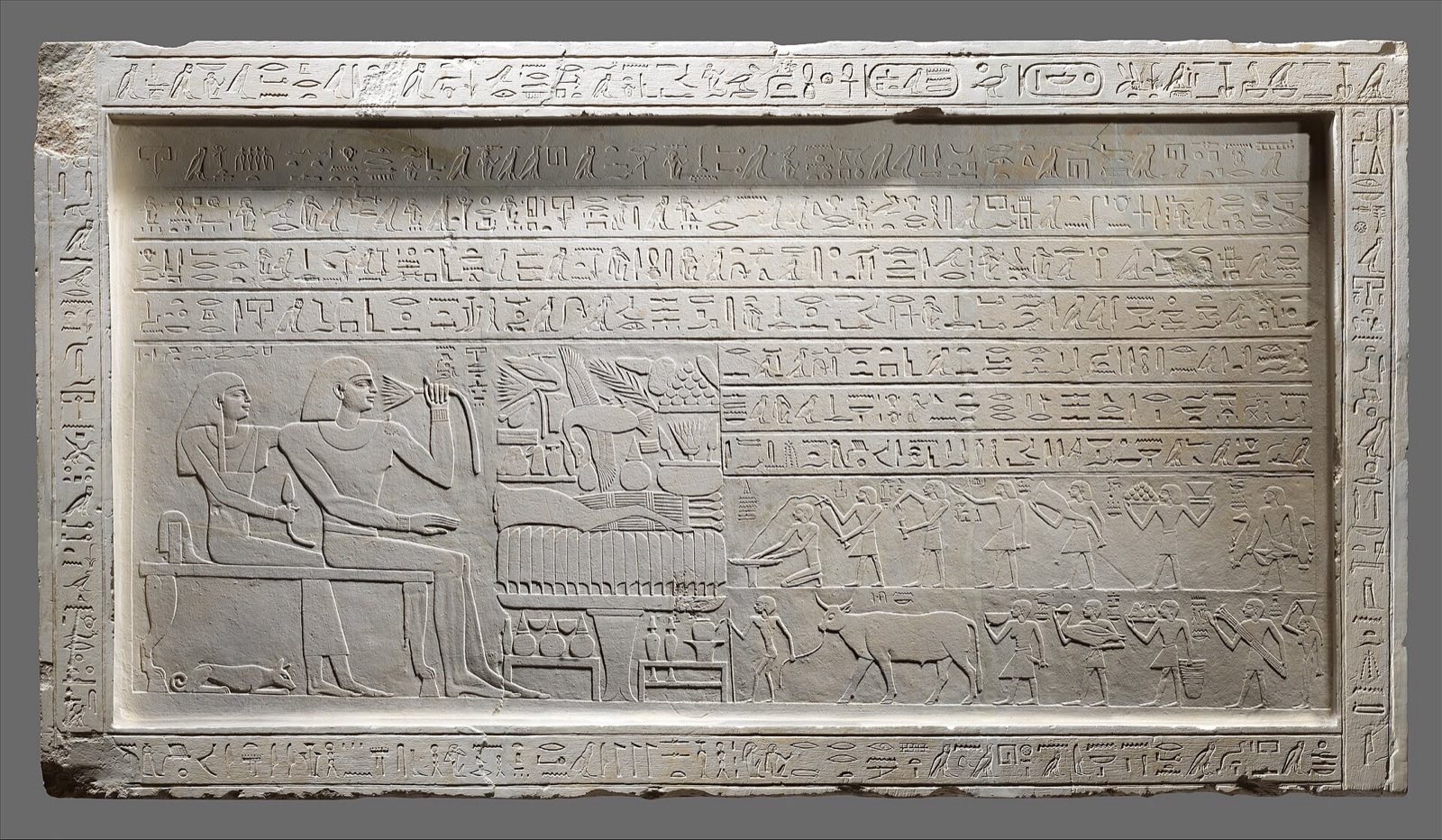
- c. 2000 BCMiddle Egyptian, the classical stageThe language of the stela at the top of this page and of the Story of Sinuhe. Later Egyptians kept writing it on monuments long after their speech had moved on.Allen §1.2 pp. 1–2; Gardiner §4 p. 5
- c. 650 BCDemotic appearsA still faster script, and a late stage of the language. It becomes the everyday way to write Egyptian.Allen §1.10 p. 8; Gardiner §8 p. 10
- 196 BCThe Rosetta StoneOne decree in hieroglyphic, Demotic and Greek. In 1822 it helps Champollion show that hieroglyphs spell sounds.Allen §1.10 p. 8, §1.12 pp. 10–11; Gardiner §10 pp. 12–15
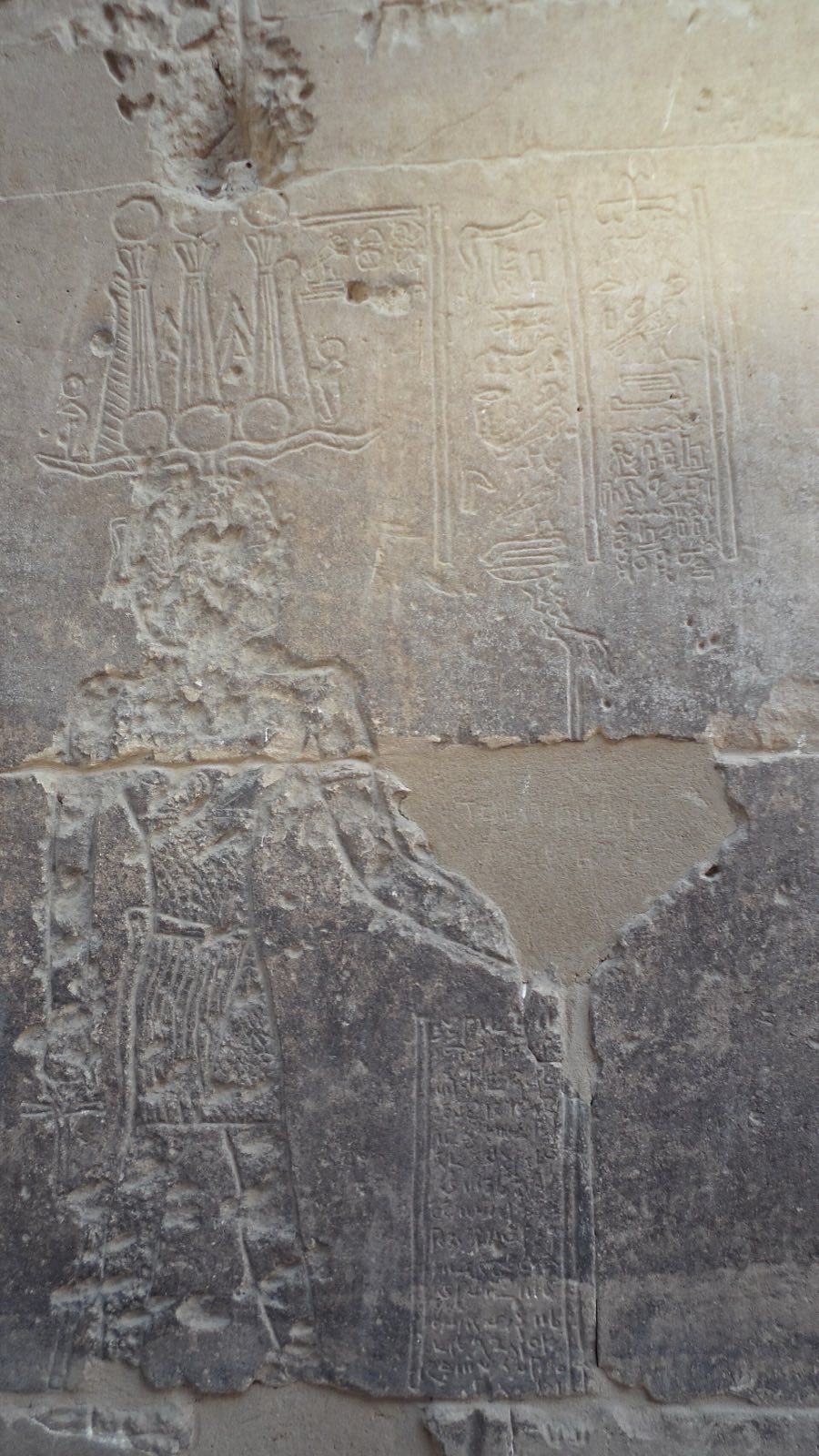
- AD 394The last dated hieroglyphsA short text beside a figure of the god Mandulis on the Gate of Hadrian at Philae, with a Demotic text next to it. After this, no dated hieroglyphic inscription is known.Allen §1.12 p. 9; Gardiner §1 p. 1, §9 p. 11
Middle Egyptian is the stage Sesh teaches and the one every grammar starts with; What is Middle Egyptian? explains why. For the whole method of reading, step by step, go on to the cornerstone guide, How to read Egyptian hieroglyphs.
 How Sesh helps
See every sign do its job, on real objects.
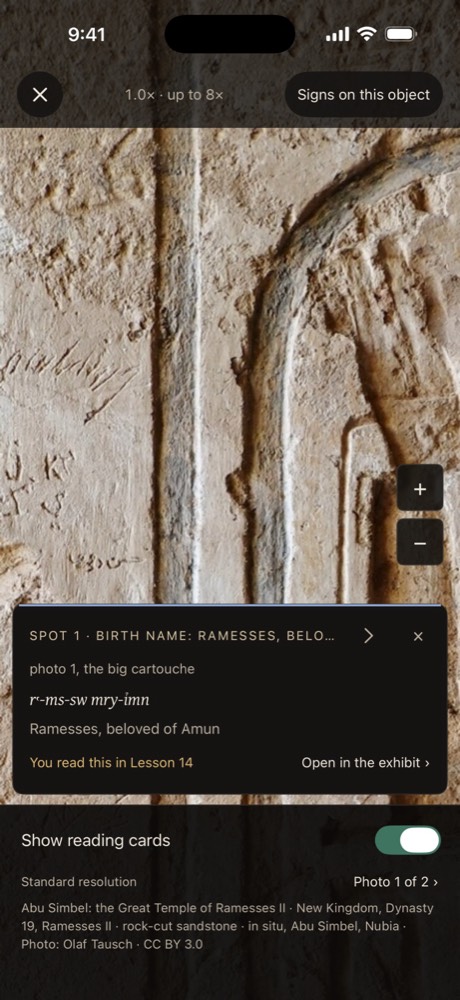
Sesh teaches Middle Egyptian from the first sign, one idea at a time: 231 lessons in 32 units, about ten minutes a day. In the Reading Room you zoom into 132 museum objects and tap a sign to see its sound, its job and a word-by-word gloss.
- 256 signs and 846 words, each with its sound, its meaning and the lesson where you met it
- Every rule cites Gardiner, Allen, Faulkner or Collier & Manley
- A translator converts. Sesh teaches you to read.
iPhone and iPad · iOS 17 or later
References
- Gardiner, Alan H. Egyptian Grammar: Being an Introduction to the Study of Hieroglyphs. 3rd edition, revised. Oxford: Griffith Institute, Ashmolean Museum, 1957.
- Allen, James P. Middle Egyptian: An Introduction to the Language and Culture of Hieroglyphs. 3rd edition. Cambridge: Cambridge University Press, 2014.
- Faulkner, Raymond O. A Concise Dictionary of Middle Egyptian. Oxford: Griffith Institute, 1962.
- Collier, Mark, and Bill Manley. How to Read Egyptian Hieroglyphs: A Step-by-Step Guide to Teach Yourself. Revised edition. London: British Museum Press, 1998.
- Sesh Reading Room: “The Narmer Palette” (Egyptian Museum, Cairo, JE 32169) and “Philae: the graffito of Esmet-Akhom” (in situ, Gate of Hadrian).
- Sesh: Learn Hieroglyphs (iOS app), course, Reading Room and sign library content, version of November 2026. Each lesson card names its source in the works above.
Sesh app content cited as “Sesh, lesson L…” or “Sesh Reading Room” is the app’s own teaching text, itself sourced to the works above. Photos are credited under each image. Not affiliated with the museums shown.