
 Türkçe
 Deutsch
 Français
Hieroglyph translator or learning hieroglyphs?
A hieroglyph translator or name converter usually swaps each letter of a name for a one-consonant sign. That makes a pleasing modern spelling, but it cannot turn an English sentence into Middle Egyptian or read an inscription for you. Learning gives you the signs, the words and the grammar, so the next text is one you can read yourself.
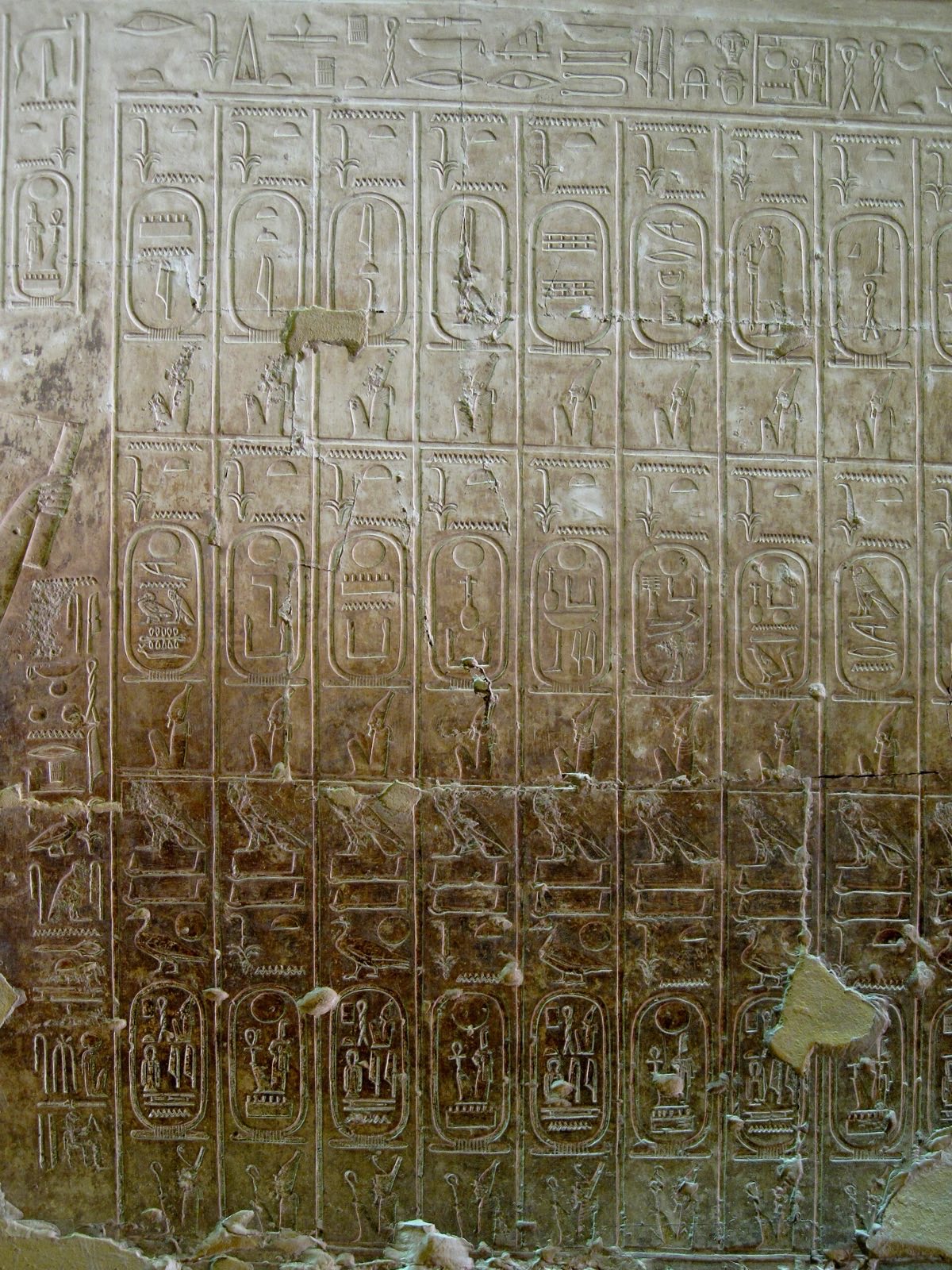
I · CONVERTERSWhat a hieroglyph translator does
Many hieroglyph “translators” are really converters: they change letters, not language.
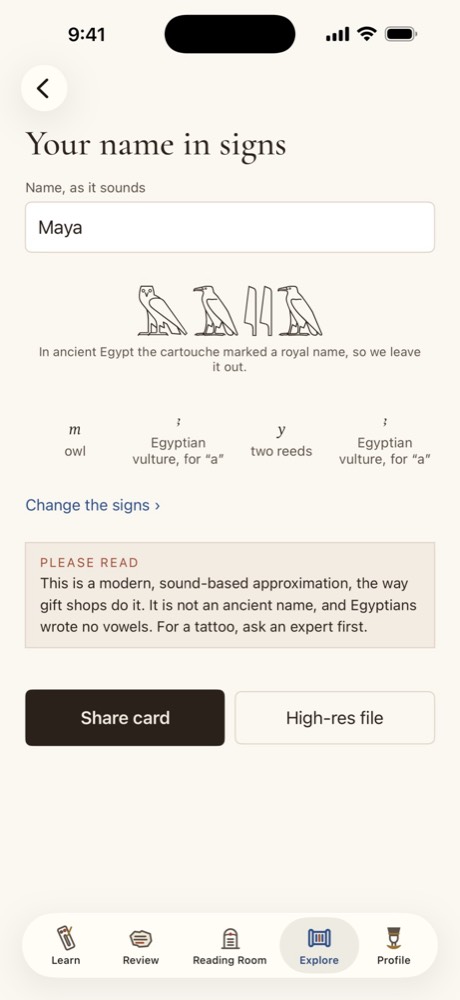
Type a name and the tool looks up each letter, or each sound, in a table of the one-consonant signs that modern books call the hieroglyphic “alphabet”: the reed leaf, the arm, the quail chick, the foot and so on. Then it lines the signs up in a row or a cartouche. Done carefully, that gives a fair modern spelling.
There is an ancient precedent. When Greek kings ruled Egypt, scribes spelled names such as Ptolemaios and Kleopatra largely with one-consonant signs, chosen by sound. A modern name in signs works the same way, with two catches: Egyptian wrote no vowels, so vowels are guessed, and some of our sounds have no Egyptian equivalent. Two careful tools can spell the same name differently, and both can be reasonable.
Other tools work the other way: you enter signs, by code or from a palette, and get dictionary meanings back. That is a useful look-up, but still not reading. You have to know which signs belong together, which are silent, and in what order the words go.
II · REAL EXAMPLESThree real examples
What letter-swapping misses, shown on words and objects from the Sesh course and Reading Room.
1 · Three everyday words
In English, “mother” has six letters, and a converter would give you six sound signs, spelling an English word the Egyptians never said. The Egyptian word is mwt, and it is written like this, beside two other common words:
Each word ends in a sign that is not read at all: the seated woman, the child, the seated man. These silent determinatives tell you what kind of word you are looking at. A letter converter has no place for them, because they stand for no letter.
2 · A formula: “an offering which the king gives”
The most common inscription in Egypt opens hundreds of stelae. On the Stela of Rehuerdjersen in New York, the top line begins like this:
Three things here are out of a converter’s reach. The first three signs are word signs, not letters: the sedge 𓇓 writes nsw, “king”, the loaf on a mat 𓊵 writes ḥtp, “offering”, and the pointed loaf 𓏙 writes dỉ, “give”. The word for “king” is written first but read last, out of respect. And the English phrase has no word-for-word match in Egyptian: the grammar is different.
3 · A royal name: Ptolemy on the Rosetta Stone
Converters do best with names, and the Rosetta Stone shows why. In this cartouche the name of King Ptolemy is spelled sound by sound, much as a name tool would spell it. The rest of the same ring is something else.
After the name comes the ankh, a word sign for “life”, then ḏt, “eternity”, which ends in the sign for land, a determinative. Last, the god’s name ptḥ is written before the hoe that writes mr, “love”, though it is read after it: mry ptḥ, “beloved of Ptah”. A converter can approximate the first half of the ring; only reading gets you the second.
III · LEARNINGWhat learning gives you
Learning does not replace the dictionary. It lets you use one.
A course takes you through the steps the standard textbooks use: the one-consonant signs, then two- and three-consonant signs, word signs and determinatives; then vocabulary; then the grammar of nouns, pronouns and verbs; then real texts. Each step makes the next object you meet more readable.
After that, a dictionary or a translation tool becomes far more useful, because you can check what it gives you.
IV · SIDE BY SIDETranslator and learning, side by side
| Task | A translator or name app | Learning to read |
|---|---|---|
| Write your name in signs | Yes, in seconds, as a modern sound-based spelling | Yes, and you know why each sign is there |
| Turn an English sentence into Middle Egyptian | No: it swaps letters, not grammar | Step by step, with the grammar behind it |
| Read a museum inscription | No | Yes, more of it with every lesson |
| Handle word signs and determinatives | No | Yes |
| Check a translation you were given | No | Yes |
| Time | Seconds | Weeks to months |
| Best for | A name graphic, a gift, a quick look-up | Reading for yourself |
V · WHEN IT’S ENOUGHWhen a translator is enough
A converter is the right tool when the result is decoration, not text:
- A name graphic for a card, a poster or a child’s room.
- A first look at the one-consonant signs: spelling your own name is a good way to meet them.
- Looking up a sign you have already found, by its code or its picture.
VI · WHEN IT ISN’TWhen it isn’t
Reach past the converter when the words have to mean something:
- A sentence or motto for an engraving or a tattoo. A converter spells the English sounds; it does not write Egyptian. Ask someone who reads Middle Egyptian, or learn enough to check it yourself.
- A museum object. You may recognise a royal name, but the offering formula, titles and dates are word signs and grammar.
- A text you want to understand, not just identify. A translation tells you what it says; reading tells you how, and lets you weigh one translation against another.
For a fair look at the apps and books on both sides, see The best apps to learn Egyptian hieroglyphs.
 How Sesh helps
Your name first, then the real thing.
Sesh has a name studio that writes your name in a cartouche you can share, and says plainly that it is a modern, sound-based spelling. Then the course takes over: 231 lessons in four stages, from your first sign to the Story of Sinuhe, with 132 museum objects to read in the Reading Room.
- 256 signs and 846 words, each sign and word explained
- Readings follow Gardiner, Allen, Faulkner or Collier & Manley
- English, Turkish, German and French; works offline
iPhone and iPad · iOS 17 or later
References
- Gardiner, Alan H. Egyptian Grammar: Being an Introduction to the Study of Hieroglyphs. 3rd edition, revised. Oxford: Griffith Institute, Ashmolean Museum, 1957.
- Allen, James P. Middle Egyptian: An Introduction to the Language and Culture of Hieroglyphs. 3rd edition. Cambridge: Cambridge University Press, 2014.
- Faulkner, Raymond O. A Concise Dictionary of Middle Egyptian. Oxford: Griffith Institute, 1962.
- Collier, Mark, and Bill Manley. How to Read Egyptian Hieroglyphs: A Step-by-Step Guide to Teach Yourself. Revised edition. London: British Museum Press, 1998.
- Sesh: Learn Hieroglyphs (iOS app), course, Reading Room and dictionary content, version of November 2026. Each lesson card names its source in the works above.
Sesh app content cited as “Sesh dictionary” or “Sesh Reading Room” is the app’s own teaching text, itself sourced to the works above. Photos are credited under each image. Not affiliated with the museums shown.