

 Türkçe
 Deutsch
 Français

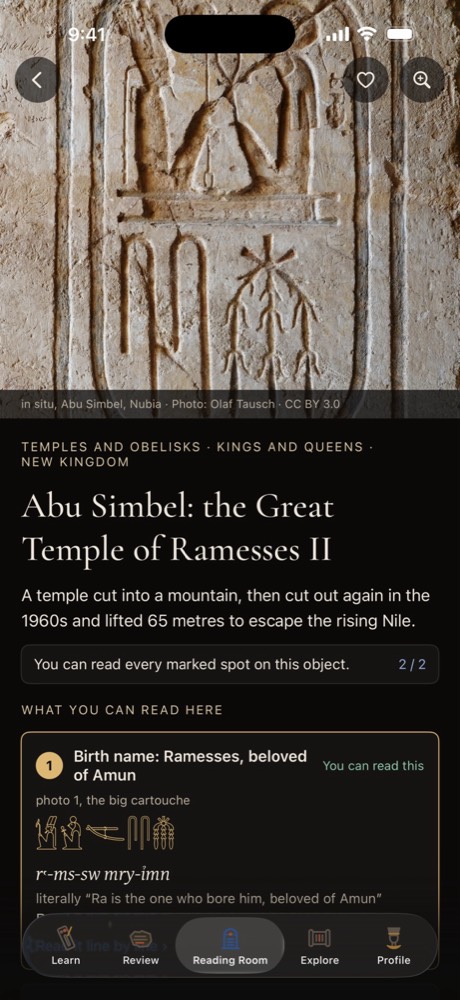
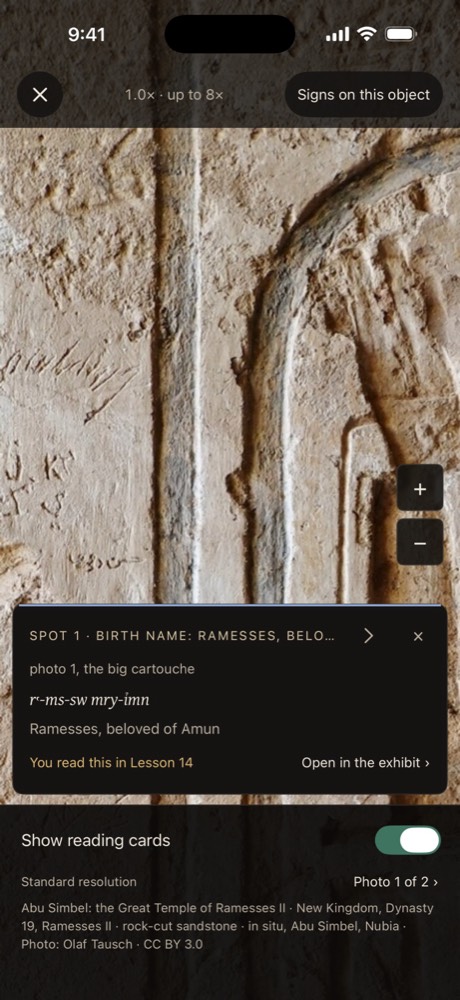
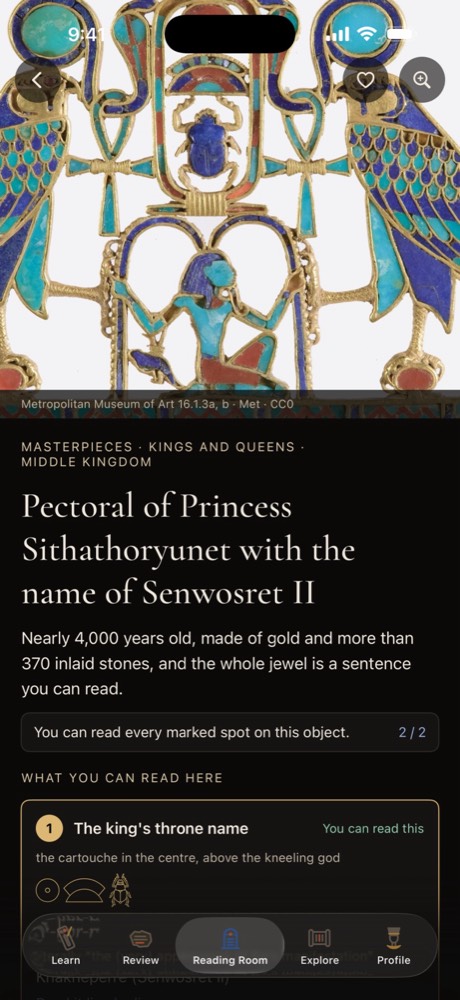
What an exhibit
gives you.
Every object in the Reading Room follows the same order, the order of reading itself: look at the object, find the line, read the signs, sound them out, take the words one by one, then translate.
- 1The photographA real photograph of the object, with its museum, inventory number and date, and the credit and licence of the photo. Zoom up to 8×.
- 2Marked spotsEach readable line is numbered on the photograph, with “Where:” telling you exactly where to look.
- 3At a glance, and the storyWhat to look for first, and a short story of the object: who made it, for whom, and why it matters.
- 4The signsEvery sign in the line, with its sound or job, what it shows and its Gardiner code. Tap one to open it in the sign library.
- 5TransliterationThe line in the standard letters Egyptologists use: ꜣ ꜥ ỉ ḥ ḫ ẖ š ṯ ḏ.
- 6Word by wordA literal version that keeps the Egyptian order, with the words English needs in brackets.
- 7Grammar noteThe rule behind the line comes from the lesson that teaches it, with the section and page of its source.
- 8TranslationA natural English translation, the last step, after you have read the signs yourself.
- 9The lesson that unlocks itLines you have not learned yet stay closed and say which lesson opens them: “You’ll learn this in Lesson 14.”
“Readings follow the standard grammars (Gardiner, Egyptian Grammar; Allen, Middle Egyptian) and, for royal names, Leprohon, The Great Name. Translations are ours.”
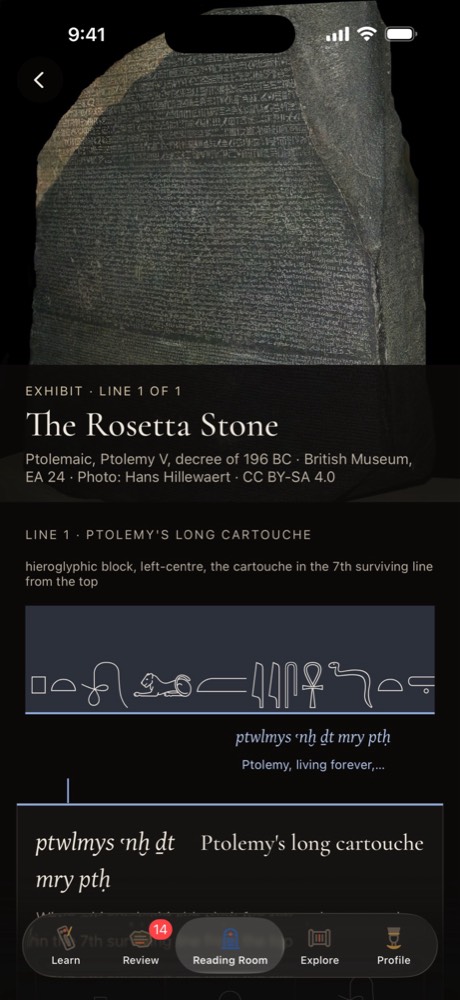
The Rosetta Stone
The same decree in three scripts: the stone that let Egyptian speak again.
A priestly decree in honour of the young Ptolemy V, carved in hieroglyphs, Demotic and Greek. Because the Greek could be read, the royal name in the hieroglyphic part became a key: Gardiner tells how the name Ptolemy, found inside a cartouche, gave the first sound values.
The broken top section is hieroglyphs; find the oval rings (cartouches) in it.
Where: hieroglyphic block, left-centre, the cartouche in the 7th surviving line from the top
The signs, one by one (16)
Word by word
'Beloved of Ptah' is said mry ptḥ, but scribes wrote Ptah's name first, out of respect. We read it in spoken order. Keep this in your pocket: it becomes a big idea in Unit 3.
Lesson 5 teaches the name Ptolemy, the one Champollion read first; Lesson 6 the whole cartouche. Both are free.
Stela of the Overseer of the Fortress Intef
A soldier's stela that opens with the name of the king he served, cut as crisply as the day it was made.
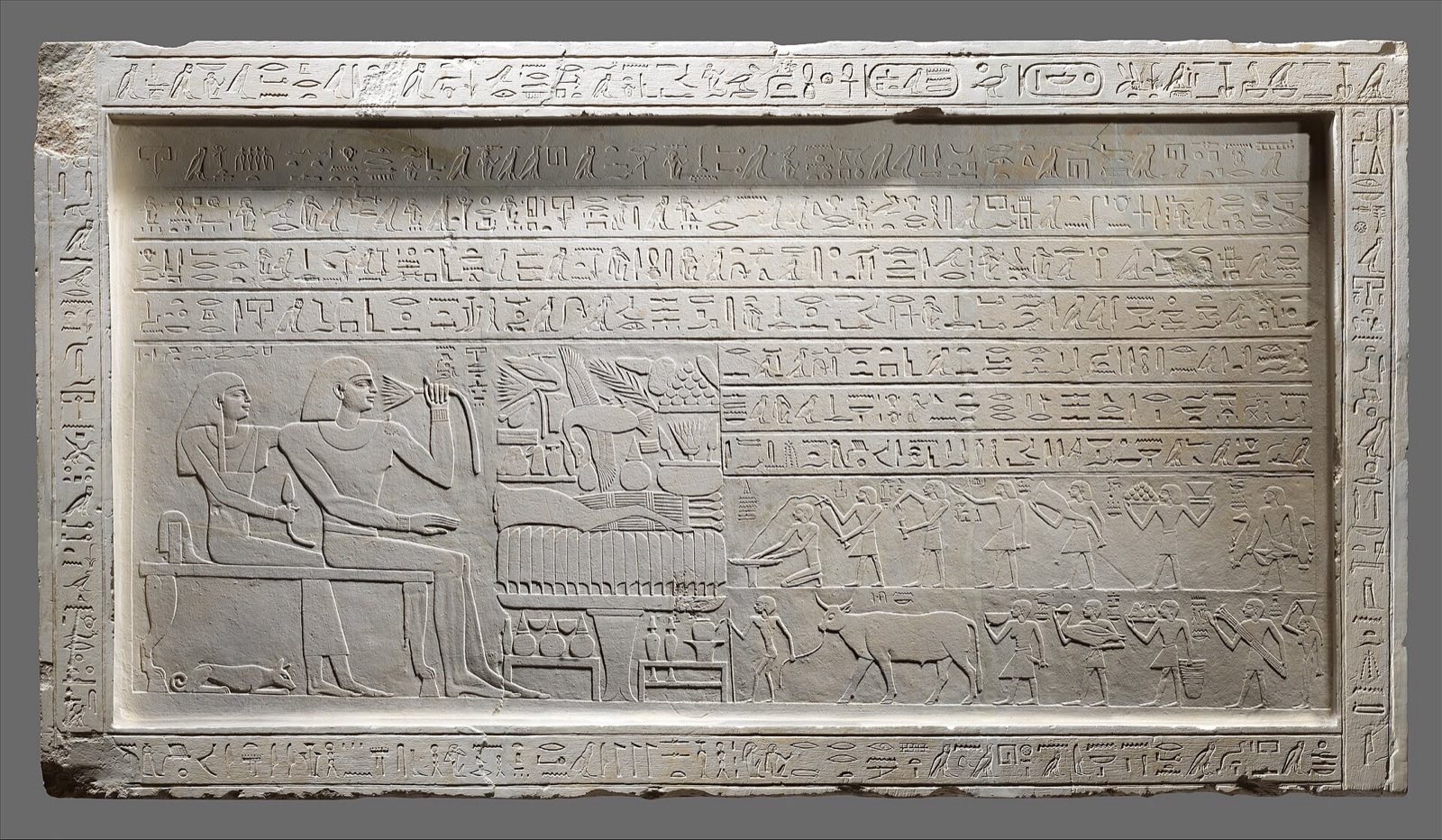
The frame band at the top dates the stela with the names of King Amenemhat I, the founder of the 12th Dynasty, before the long text for Intef, an overseer of a fortress (Met title). Inside, four lines run above a scene of Intef and Iti at an offering table, with offering bearers and cattle below.
Two cartouches side by side in the top border, with a duck between them.
Spot 1 · King of Upper and Lower Egypt
Where: top frame band, right of the two cartouches: sedge and bee
The title is abbreviated: the sedge and the bee carry the whole meaning, each with a t below. It literally means 'he of the sedge and the bee': the plant of the south and the insect of the north.
Spot 2 · Son of Ra, Amenemhat
Where: top frame band, centre-right: duck and disk, then the left cartouche
sꜣ 'son' + rꜥ 'Ra' = 'son of Ra'. Two nouns side by side, no word for 'of'. You'll name this construction in lesson 31.
Spot 2 opens with Lesson 29 for sꜣ rꜥ; its signs come from Lesson 11 (ỉmn), Lesson 13 (F4) and Lesson 19 (G17), as the app notes.
Eight galleries,
one collection.
Walk the collection by theme. An object can hang in more than one gallery: the Rosetta Stone is in Scripts and decipherment and in Masterpieces. A masterpiece of the week changes every week.
- The Merenptah ("Israel") Stela
- The Narmer Palette
- Stela of the Overseer of the Fortress Intef
- The Westcar Papyrus (Papyrus Berlin 3033)
- Ostracon recording the accession of Seti II
- The Merenptah ("Israel") Stela
- The Rosetta Stone
- Stela of Intef and Nesumontu
- False door of the Royal Sealer Neferiu
- The Book of the Dead of Hunefer
- The Rosetta Stone
- The Narmer Palette
- Ostracon with a grid of month-days and names
- Edfu, temple of Horus: cartouches of Ptolemy IV
- Dendera: Cleopatra VII before the goddess's crown
- Stela of the Overseer of the Fortress Intef
- Stela of Rehuerdjersen
- Stela of Senu
- Stela of Dedu
- Stela of Intef and Nesumontu
- Stela of Senu
- The Papyrus of Ani: the Weighing of the Heart
- Kneeling statue of Yuny holding a shrine
- Stela of the treasurer Ikhernofret
- The Book of the Dead of Nany, Singer of Amun
- Stela of Dedu
- The Edwin Smith Surgical Papyrus
- The Rhind Mathematical Papyrus
- Ostracon recording the accession of Seti II
- Ostracon dated to Year 21 of Ramesses II
- False door from the Tomb Chapel of Raemkai
- Karnak: the throne name of Ramesses II, twice
- Karnak: the cartouches of Seti II, with Seth hacked out
- Karnak, 8th pylon: a throne name of Thutmose III from the co-regency
- Deir el-Bahari: Thutmose III's names beside an erased queen
- The Story of Sinuhe (Papyrus Berlin 3022, "Sinuhe B")
- The Eloquent Peasant (Papyrus Berlin 10499)
- The Westcar Papyrus (Papyrus Berlin 3033)
- Hieratic copy of the Teaching of Amenemhat I
- Stela of the treasurer Ikhernofret
All 132,
where they are.
The full list, grouped the way the app’s visit mode groups them, with each object’s museum and inventory number. A few objects, from the stelae you read in Stages 2 and 3, appear in the Reading Room once you reach their lesson.
The MetNew York48
- Stela of the Overseer of the Fortress IntefThe Metropolitan Museum of Art, 57.95
- Stela of RehuerdjersenThe Metropolitan Museum of Art, 12.182.1
- Stela of SenuThe Metropolitan Museum of Art, 12.182.39
- Stela of DeduThe Metropolitan Museum of Art, 16.10.333
- Stela of Intef and NesumontuThe Metropolitan Museum of Art, 16.10.327
- Stela of RenisenebThe Metropolitan Museum of Art, 63.154
- Stela from a Chapel Niche of AnuThe Metropolitan Museum of Art, 69.30
- Stela of KhonsuThe Metropolitan Museum of Art, 21.2.69
- Stela of Merenptah and Ina (a private man, not the king)The Metropolitan Museum of Art, 04.2.533
- False door from the tomb of Metjetji (offering panel)The Metropolitan Museum of Art, 64.100
- False door of the Royal Sealer NeferiuThe Metropolitan Museum of Art, 12.183.8
- False door from the Tomb Chapel of RaemkaiThe Metropolitan Museum of Art, 08.201.1e
- Ostracon recording the accession of Seti IIThe Metropolitan Museum of Art, 14.6.217
- Ostracon dated to Year 21 of Ramesses IIThe Metropolitan Museum of Art, 09.184.183
- Hieratic copy of the Teaching of Amenemhat IThe Metropolitan Museum of Art, 32.1.119
- Ostracon with a grid of month-days and namesThe Metropolitan Museum of Art, 26.3.169
- Kneeling statue of Yuny holding a shrineThe Metropolitan Museum of Art, 33.2.1
- Seated statue of HatshepsutThe Metropolitan Museum of Art, 29.3.2
- Offering table of Tjaenhesret, priest of Thoth, son of IaaThe Metropolitan Museum of Art, 48.149.5
- Offering table with a statuette of SehetepibThe Metropolitan Museum of Art, 22.1.107a, b
- Offering table of Seti IThe Metropolitan Museum of Art, 22.2.22
- Canopic jar of ManuwaiThe Metropolitan Museum of Art, 18.8.12a, b
- Canopic jar of MinmoseThe Metropolitan Museum of Art, 2005.106a, b
- Coffin of NakhtkhnumThe Metropolitan Museum of Art, 15.2.2a, b
- Coffin of the estate manager KhnumhotepThe Metropolitan Museum of Art, 12.182.131a–c
- Travertine shabtiThe Metropolitan Museum of Art, 45.4.7
- Foundation-deposit tablet of Mentuhotep IIThe Metropolitan Museum of Art, 22.3.187
- Foundation-deposit plaque of Senwosret IThe Metropolitan Museum of Art, 32.1.46
- Lid of an ointment jar from a foundation deposit of HatshepsutThe Metropolitan Museum of Art, 25.3.49a, b
- Plaque with the cartouche of TawosretThe Metropolitan Museum of Art, 21.2.94
- Heart scarab of HatneferThe Metropolitan Museum of Art, 36.3.2
- Heart scarab of KhayThe Metropolitan Museum of Art, 16.10.402
- The "lion hunt" scarab of Amenhotep IIIThe Metropolitan Museum of Art, 26.7.264
- The "marriage" scarab of Amenhotep III and TiyeThe Metropolitan Museum of Art, 10.130.1643
- Scarab inscribed for Maatkare (Hatshepsut)The Metropolitan Museum of Art, 27.3.231
- The Temple of DendurMetropolitan Museum of Art 68.154
- The Mastaba Tomb of PernebMetropolitan Museum of Art 13.183.3
- Pectoral of Princess Sithathoryunet with the name of Senwosret IIMetropolitan Museum of Art 16.1.3a, b
- Granite Sphinx of HatshepsutMetropolitan Museum of Art 31.3.166
- Kneeling Statue of Senenmut with a Hathor SistrumMetropolitan Museum of Art 48.149.7
- The Book of the Dead of Nany, Singer of AmunMetropolitan Museum of Art 30.3.31
- Senwosret III as a SphinxMetropolitan Museum of Art 17.9.2
- The Metternich Stela (Cippus of Horus)Metropolitan Museum of Art 50.85
- Outer Coffin of Henettawy, Singer of Amun-ReMetropolitan Museum of Art 25.3.182a, b
- Coffins of Khonsu, from the tomb of SennedjemMetropolitan Museum of Art 86.1.1a, b (outer coffin of Khonsu)
- Model Scribe's Palette Inscribed for AmenhotepMetropolitan Museum of Art 37.2.1
- Queen Nefertari Led by Isis (facsimile painting)Metropolitan Museum of Art 30.4.142, facsimile by Charles K. Wilkinson of a painting in the tomb of Nefertari (QV66), Valley of the Queens
- Silver Scarab of the Storehouse Overseer WahMetropolitan Museum of Art 40.3.12
British MuseumLondon16
- The Rosetta StoneBritish Museum, EA 24
- The Book of the Dead of HuneferBritish Museum, EA 9901
- The Papyrus of Ani: the Weighing of the HeartBritish Museum, EA 10470
- The Rhind Mathematical PapyrusBritish Museum, EA 10057
- Stela of Ity, dated to the reign of Senwosret IBritish Museum, EA 586
- Stela of the governor Inhuretnakht and his wife HuiBritish Museum, EA 1783
- Stela of Khu and her two husbandsBritish Museum, EA 571
- Stela of the governor NakhtiBritish Museum, EA 143
- Stela of Amenemhat, dated to Amenemhat II (Budge's drawing)British Museum, EA 567
- Stela dated to year 28 of Amenemhat III (Budge's drawing)British Museum, EA 827
- Stela of the treasurer Tjetji (Scott-Moncrieff's drawing)British Museum, EA 614
- Nebamun's Geese: counting the estate's flocksBritish Museum EA 37978
- The Great Harris PapyrusBritish Museum EA 9999
- The Serabit Sphinx: hieroglyphs meet the first alphabetBritish Museum EA 41748
- Sphinx of TaharqaBritish Museum EA 1770
- The Hamadab Stela in MeroiticBritish Museum
Sites in EgyptTemples and tombs30
- Karnak: the throne name of Ramesses II, twicein situ, Karnak
- Karnak: the cartouches of Seti II, with Seth hacked outin situ, Karnak
- Karnak, 8th pylon: a throne name of Thutmose III from the co-regencyin situ, Karnak, 8th pylon
- Deir el-Bahari: Thutmose III's names beside an erased queenin situ, mortuary temple of Hatshepsut, Deir el-Bahari
- Pyramid Texts in the pyramid of Unasin situ, pyramid of Unas, Saqqara
- Edfu, temple of Horus: cartouches of Ptolemy IVin situ, temple of Horus, Edfu
- Dendera: Cleopatra VII before the goddess's crownin situ, temple of Hathor, Dendera
- Philae, temple of Isis: a band of royal titlesin situ, temple of Isis, Philae (Agilkia)
- Philae: the graffito of Esmet-Akhom, the last dated hieroglyphic inscriptionin situ, Gate of Hadrian, Philae
- The Abydos King List of Seti Iin situ, temple of Seti I, Abydos
- The colossus of Ramesses II at MemphisMit Rahina open-air museum, Memphis
- Abu Simbel: the Great Temple of Ramesses IIin situ, Abu Simbel, Nubia
- The Standing Obelisk of Hatshepsut at Karnakin situ, Karnak, temple of Amun
- Medinet Habu: the names of Ramesses III under a vulture's wingsin situ, mortuary temple of Ramesses III, Medinet Habu, Thebes; ceiling relief in the gateway of the second pylon
- Kom Ombo: a Ptolemy before the godsin situ, temple of Sobek and Haroeris, Kom Ombo; column relief in the court
- The Tomb of Seti I (KV17): the king embraced by Horusin situ, Valley of the Kings, tomb KV17
- The Obelisk of Thutmose III in Istanbulin situ, Hippodrome (Sultanahmet Square), Istanbul; originally from Karnak
- Ramesses II striking his enemies, Great Hall of Abu Simbelin situ, great pillared hall of the Great Temple of Abu Simbel
- The Red Chapel of HatshepsutKarnak Open Air Museum, precinct of Amun-Ra
- The Mastaba of Ti: a parade of offering-bearersin situ, Saqqara
- The Great Hypostyle Hall at Karnakin situ, temple of Amun-Ra, Karnak
- The Great Hymn to the Aten, tomb of Ay at Amarnain situ, tomb of Ay (Amarna tomb 25), Tell el-Amarna
- Seti I in his Temple at Abydosin situ, temple of Seti I, Abydos
- The Ramesseum: Ramesses II's temple of millions of yearsin situ, the Ramesseum, western Thebes
- The White Chapel of Senwosret IKarnak Open Air Museum
- The Tomb of Sennedjem: Anubis tends the mummyin situ, tomb of Sennedjem (TT1), Deir el-Medina
- Dendera: the sky goddess Nut bathes Hathor in sunlightin situ, temple of Hathor, Dendera
- The Tomb of Ramesses V and VI (KV9): the Books of the Skyin situ, KV9, Valley of the Kings
- The Battle of Kadesh (Breasted's drawing of the Ramesseum relief)in situ, Ramesseum, western Thebes
- The Tomb of Menna: a harvest (archive photograph)in situ, tomb of Menna (TT69), Sheikh Abd el-Gurna, Thebes
Cairo · GEMEgyptian Museum and Grand Egyptian Museum12
- The Merenptah ("Israel") StelaEgyptian Museum, Cairo, JE 31408
- The Narmer PaletteEgyptian Museum, Cairo, JE 32169 / CG 14716
- Tutankhamun's cartouche-shaped box (with a travertine ewer)Egyptian Museum, Cairo
- The Golden Throne of Tutankhamun (back panel)Egyptian Museum, Cairo
- Triad of Menkaure with Hathor and a nome goddessEgyptian Museum, Cairo
- Prince Rahotep and NofretEgyptian Museum, Cairo
- The Carrying Chair of Queen HetepheresEgyptian Museum, Cairo
- Pyramidion of Amenemhat IIIEgyptian Museum, Cairo
- Tutankhamun's Scarab Pectoralfrom the tomb of Tutankhamun, KV62; Egyptian Museum Cairo / Grand Egyptian Museum
- The Gold Mask of Tutankhamun, seen from behindEgyptian Museum Cairo / Grand Egyptian Museum
- Tutankhamun's Burial Chamber: the funeral processionin situ, tomb of Tutankhamun, KV62, Valley of the Kings
- Canopic Coffinette of TutankhamunEgyptian Museum Cairo / GEM
BerlinÄgyptisches Museum, Neues Museum8
- The Story of Sinuhe (Papyrus Berlin 3022, "Sinuhe B")Ägyptisches Museum und Papyrussammlung, Berlin, P. 3022
- The Eloquent Peasant (Papyrus Berlin 10499)Ägyptisches Museum und Papyrussammlung, Berlin, P. 10499
- The Westcar Papyrus (Papyrus Berlin 3033)Ägyptisches Museum und Papyrussammlung, Berlin, P. 3033
- A Deir el-Bahari block with the throne name of Thutmose IIINeues Museum, Berlin
- The bust of NefertitiNeues Museum, Berlin, ÄM 21300
- Stela of the treasurer IkhernofretÄgyptisches Museum, Berlin, ÄM 1204
- House Altar of Akhenaten and NefertitiÄgyptisches Museum Berlin 14145
- Block Statue of Senenmut with Princess NeferureÄgyptisches Museum Berlin
TurinMuseo Egizio4
- Funerary Stela of Christopher, in CopticMuseo Egizio, Turin, S 18158
- The Turin King ListMuseo Egizio, Turin, C 1874
- Seated Statue of Ramesses II, TurinMuseo Egizio, Turin, C 1380
- Stela of Padikhonsu: hieroglyphs and Demotic on one stoneMuseo Egizio, Turin, C 1578
LouvreParis4
- The Luxor obelisk in Paris (Place de la Concorde)Paris, Place de la Concorde; from Luxor temple
- Slab Stela of Princess NefertiabetMusée du Louvre E 15591
- The Dendera ZodiacMusée du Louvre D 38
- Amun Protecting TutankhamunMusée du Louvre E 11609
ElsewhereOxford, Leiden, Moscow, Palermo and more10
- The Edwin Smith Surgical PapyrusNew York Academy of Medicine
- The Palermo StoneMuseo Archeologico Regionale Antonino Salinas, Palermo, inv. 1028
- The Decree of Canopus
- Papyrus Prisse: the Teaching of PtahhotepBibliothèque nationale de France, Papyrus Prisse
- The Ebers Papyrus (1875 facsimile)Leipzig University Library
- The Admonitions of IpuwerRijksmuseum van Oudheden, Leiden, Papyrus Leiden I 344
- The Report of WenamunPushkin Museum, Moscow
- The Narmer MaceheadAshmolean Museum, Oxford
- The Moscow Mathematical Papyrus, Problem 14Pushkin Museum, Moscow
- The Alabaster Sarcophagus of Seti ISir John Soane's Museum, London

Every photo,
credited.
The Reading Room uses photographs from museum open-access collections and Wikimedia Commons. Many are public domain (CC0); the rest are under the Creative Commons licence named on each photo, in the app and on this page. No image is AI-generated, and no object is drawn or reconstructed.
Sesh is not affiliated with the museums whose objects it shows. The inventory numbers and dates come from each museum’s own record.
- Ramesses II striking his enemies, Great Hall of Abu SimbelPhoto: Mustang Joe · CC0
- Pectoral of Sithathoryunet, The Met 16.1.3a, b (in the app screen)The Metropolitan Museum of Art · CC0
- The Rosetta Stone, British Museum EA 24 (in the app screen)Photo: Hans Hillewaert · CC BY-SA 4.0
- Stela of the Overseer of the Fortress Intef, The Met 57.95The Metropolitan Museum of Art · CC0
- Abu Simbel inscriptions (in the app screens)Photo: Olaf Tausch · CC BY 3.0
- The Temple of Dendur, The MetThe Metropolitan Museum of Art · CC0
- Tomb of Ramesses V and VI (KV9), the Books of the SkyPhoto: Diego Delso · CC BY-SA 4.0

