
 Türkçe
 Deutsch
 Français
The Egyptian cartouche
A cartouche is the oval ring drawn around a royal name. The Egyptians called it šnw, from a verb meaning “to encircle”; it has no sound of its own and simply says “a royal name is inside”. A king had five names, and two of them went into cartouches: the throne name, after the title nsw-bỉty “King of Upper and Lower Egypt”, and the birth name, after sꜣ rꜥ “Son of Ra”.
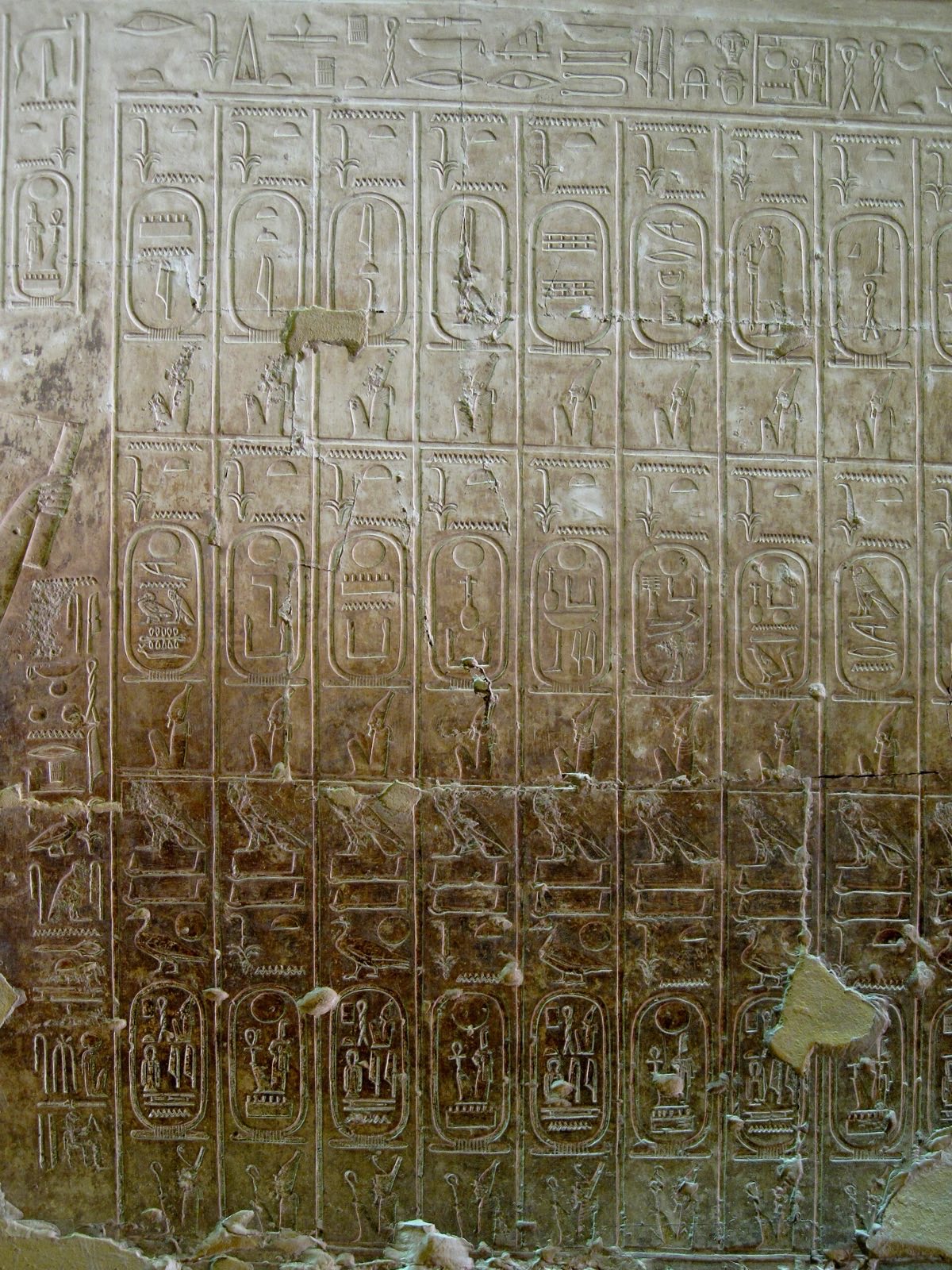
A cartouche is the easiest thing to find on an Egyptian monument, and often the first thing anyone reads. Inside the oval is the name of a king or queen. Knowing how royal names were built turns those ovals from decoration into words.
This guide goes deeper on royal names. For a first introduction to the signs and to reading direction, see the cornerstone guide, How to read Egyptian hieroglyphs.
01What a cartouche is
The Egyptians called the ring šnw, from a verb meaning “to encircle”. It has no sound of its own. It tells the reader one thing: the name inside is royal. The tied ends show as a short bar at one end of the oval.
The ring began as a plain circle and first appears around a king’s name in the 3rd Dynasty, under King Sanakht (Leprohon p. 8). At first it stood for the whole world under the king’s rule; in time it became simply a sign that a name was royal. After the Middle Kingdom a queen’s name, or a prince’s or princess’s, could also sit inside one (Allen p. 82).
02The five names of a king
From the 5th Dynasty on, each king took five names when he came to the throne, together called the royal titulary. Each name has its own title in front of it. Only the last two are written in cartouches (Gardiner pp. 71–74; Allen pp. 81–83).
| Name | Title in front | What it says | Example | |
|---|---|---|---|---|
| 1 | Horus name | 𓅃 falcon on the 𓊁 serekh | The oldest name: the king as Horus in his palace. Written inside the serekh, a palace front. | mry-tꜣwy “beloved of the Two Lands” (Pepi I) |
| 2 | Two Ladies name | 𓅒 nbty | Nekhbet the vulture (Upper Egypt) and Wadjet the cobra (Lower Egypt), the king’s protectors. No frame. | — |
| 3 | Golden Horus or Gold Falcon | a falcon on the sign for gold 𓋞 | Its exact meaning is still debated. No frame. | — |
| 4 | Throne name prenomen | 𓇓𓏏𓆤𓏏 nsw-bỉty “King of Upper and Lower Egypt” | Taken at the coronation. The newest of the five, yet from the Middle Kingdom on the main one. In a cartouche. | 𓇳𓏠𓆣 mn-ḫpr-rꜥ Menkheperre (Thutmose III) |
| 5 | Birth name nomen | 𓅭𓇳 sꜣ rꜥ “Son of Ra” | The name the king had before he was crowned. In a cartouche. | 𓅝𓄟𓋴 ḏḥwty-ms Thutmose |
The throne name was what the Egyptians themselves used for a king, and it alone was often enough. Egyptologists, on the other hand, use the birth name plus a number: Thutmose III, Ramesses II. The numbers are modern. Many kings were named after fathers or grandfathers, and the throne names already told them apart (Allen p. 83). The title “Son of Ra” is older than the five-name system: King Radjedef of the 4th Dynasty was the first to use it (Leprohon p. 19).
After the cartouche come short wishes that are not part of the name: 𓏙𓋹 dỉ ꜥnḫ “given life”, ꜥnḫ ḏt “living forever”, mỉ rꜥ ḏt “like Ra forever” (Gardiner p. 71).
03Gods go first: honorific transposition
Out of respect, scribes wrote a god’s name before the words it belongs with, even though it was spoken after them. Egyptologists call this honorific transposition. We transliterate in spoken order and join the parts with hyphens (Gardiner §57 p. 51; Allen §4.15 pp. 52–53).
04Three real cartouches, read
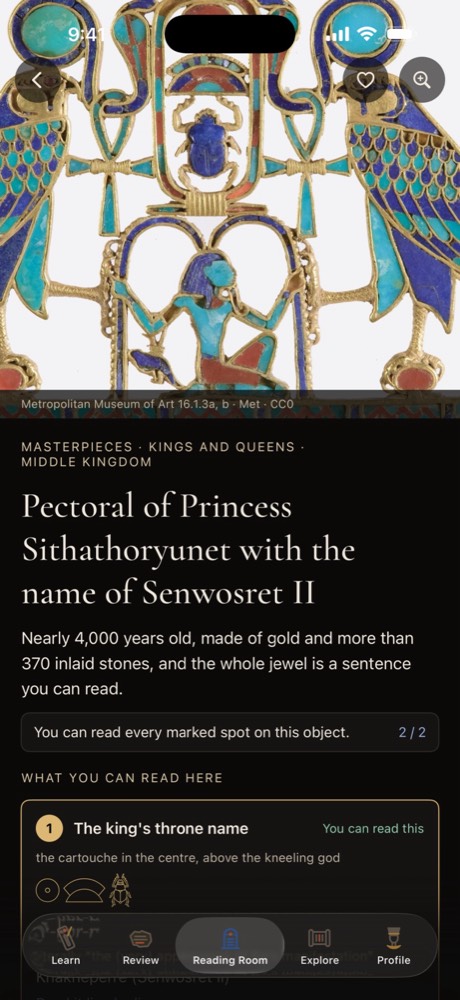
Here are three cartouches from objects you can see in museums today, read sign by sign. The readings are the ones Sesh uses, each tied to its source.
05Two cartouches, one king
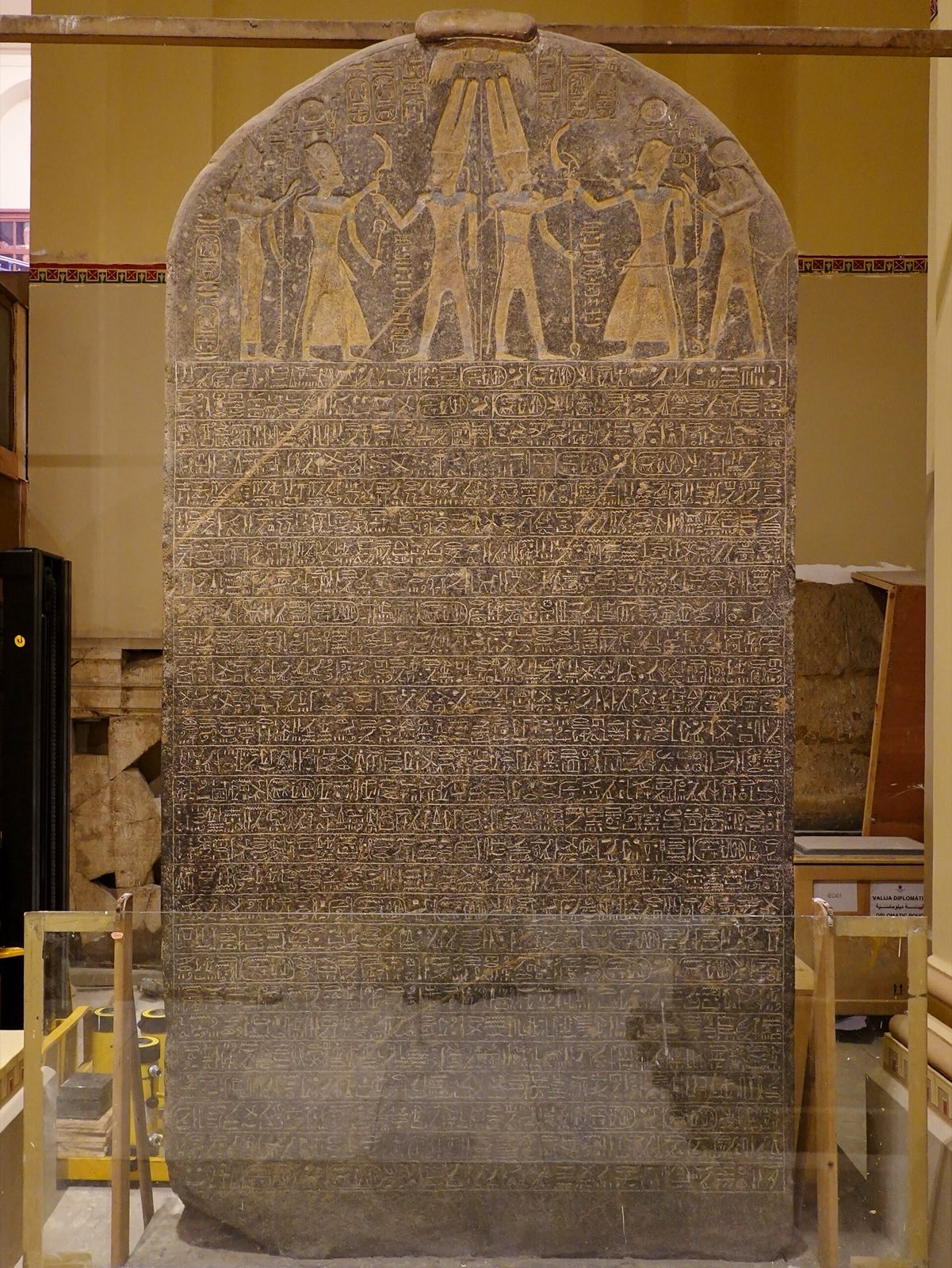
On temple walls and stelae a king’s two cartouches usually come together, each with its own title in front. Once you can recognise the sedge and bee 𓇓𓆤 and the duck with the sun disk 𓅭𓇳, you know which ring holds which name before you read a single sign inside it.
06Your name in a cartouche
Souvenir shops, websites and apps, Sesh included, will write your name in hieroglyphs inside a cartouche. It is a lovely keepsake and a good way to learn the single-consonant signs. It helps to know what it is, and what it is not.
Want to understand the signs inside the ring, not just the ring? The silent signs that close so many words are explained in Egyptian determinatives, explained.
 How Sesh helps
Read the names on the objects themselves
Sesh starts with a cartouche. Lesson 1 reads Khufu’s name on a relief at the Met; lessons 5 and 6 follow Champollion to Ptolemy on the Rosetta Stone; Unit 3 brings the gods who go first; Unit 6, The King’s Names, covers nsw-bỉty, “Son of Ra”, throne names on scarabs and the Horus name.
- In the Reading Room, each cartouche is marked on the museum photo, with its signs, sounds, a word-by-word gloss and the translation.
- Your name in a cartouche to share, clearly labelled as a modern sound-based approximation.
- Lessons 1 to 9, from Khufu to Cleopatra, are free.
iPhone and iPad · iOS 17 or later
References
- Gardiner, Alan H. Egyptian Grammar: Being an Introduction to the Study of Hieroglyphs. 3rd edition, revised. Oxford: Griffith Institute, Ashmolean Museum, 1957.
- Allen, James P. Middle Egyptian: An Introduction to the Language and Culture of Hieroglyphs. 3rd edition. Cambridge: Cambridge University Press, 2014.
- Leprohon, Ronald J. The Great Name: Ancient Egyptian Royal Titulary. Edited by Denise M. Doxey. Writings from the Ancient World 33. Atlanta: Society of Biblical Literature, 2013.
- Faulkner, Raymond O. A Concise Dictionary of Middle Egyptian. Oxford: Griffith Institute, 1962.
- Collier, Mark, and Bill Manley. How to Read Egyptian Hieroglyphs: A Step-by-Step Guide to Teach Yourself. Revised edition. London: British Museum Press, 1998.
- Sesh: Learn Hieroglyphs (iOS app), course, Reading Room and sign library content, version of November 2026. Each lesson card names its source in the works above. Reading Room entries “The Rosetta Stone”, “Pectoral of Princess Sithathoryunet”, “Deir el-Bahari”, “The Merenptah Stela”, “The Abydos King List”; lessons L01, L05–L06, L12, L14, L28–L33.
Sesh app content cited as “Sesh, lesson L…” or “Sesh Reading Room” is the app’s own teaching text, itself sourced to the works above. Photos are credited under each image. Not affiliated with the museums shown.