Türkçe
 Deutsch
 Français
You need
nothing.
No Latin, no Greek, no grammar terms, no account. Sesh teaches Middle Egyptian, the classical stage of the ancient Egyptian language, from the very first sign. Every sign, word and rule arrives at the moment you need it.
 Coming soon to the App Store
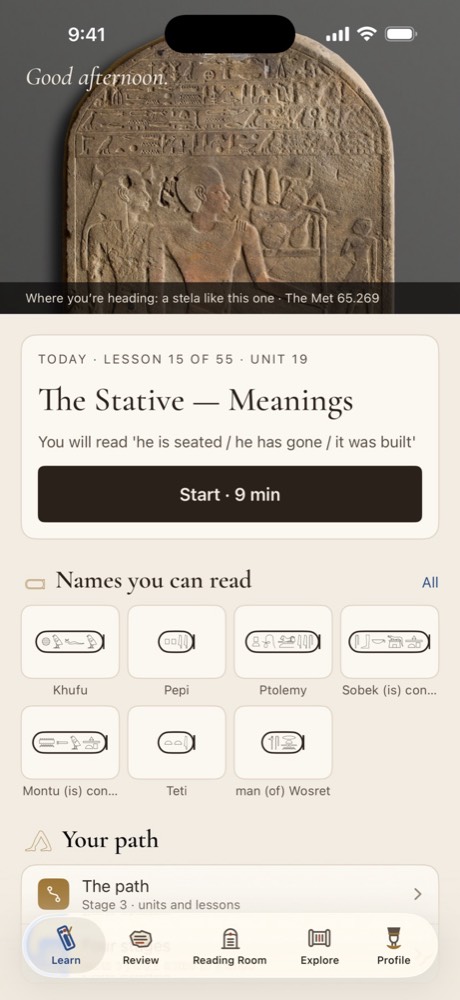
Three sound-signs inside a cartouche, the chick used twice. You will read it on a relief at The Met.
Three things.
That is all.
You do not need to know another ancient language, own a grammar book or be able to draw. The reference books are named on every rule, so you can look things up later if you ever want to.
With iOS 17 or later. The course lives on the device, so it works offline: on a train, on a plane, in a museum gallery.
Each lesson tells you how long it takes before you start. Lesson 1 takes four minutes, lesson 2 six. Spaced review keeps what you learned.
No account, no sign-up. Open the app and the first lesson is waiting, on a real object from The Metropolitan Museum of Art.
Your first
ten minutes.
Lesson 1, Khufu, takes four minutes. Lesson 2, Pepi, takes six. Here is lesson 1 exactly as it runs in the app, step by step.
“Above them, a small oval ring holds a name. Give us three minutes and you will read it yourself.”
-
01Card · the ideaLanguage is not script
Egyptian is a language; hieroglyphs are one way of writing it, the way the Latin alphabet is one way of writing English. Source: Allen §§1.1–1.4.
-
02Sign card𓐍ḫA rough “kh”, like the ch in Scottish “loch”
Sign Aa1. What it shows is uncertain: Gardiner suggests a placenta, Allen leaves it open, Manley sees a ball of twine. Its sound is certain.
-
03Quick test“What sound does this sign make?”
Four buttons: ḫ, w, f, r. A wrong answer explains itself.
-
04Sign card𓅱wA quail chick
Sign G43, written w and usually said “oo”.
-
05Quick test“And this one?”
-
06Sign card𓆑fA horned viper
Sign I9. Look for the two little horns on its head.
-
07Quick test“Which sign writes f?”
Now the other way round: from the sound to the sign.
-
08CardOne sign, used twice
A sound-sign is like a letter: it can come back as often as the word needs it.
-
09Sign card𓍷The cartouche: a frame, not a sound
Sign V10, a loop of doubled rope tied into an oval. When you see it, a king or queen is inside.
-
10Quick test“What does the oval ring tell you?”
-
11Word card𓐍𓅱𓆑𓅱ḫwfwKhufu
Disc, chick, viper, chick again.
-
12Quick test“How does this name read?”
ḫwfw, ḫfww or wḫfw. Read top to bottom.
-
13CardThree ways to write one name
ḫwfw is the transliteration, Khufu the name in modern books, “KHOO-foo” how Egyptologists say it aloud.
-
14Culture cardThe man behind the name
Khufu ruled in the Fourth Dynasty and built the Great Pyramid at Giza. Greek writers called him Cheops.
-
15Culture cardA short name for a longer one
The full form adds the god Khnum: ẖnmw-ḫw.f-wỉ, “Khnum, he protects me”.
-
16On the photoTap the oval ring that holds a king’s name
Back on the limestone relief: find either cartouche above the cattle.
-
17Quick checkTwo last questions
“Hieroglyphs are…” and “Which one is the transliteration?”
“You read a pharaoh’s name, 4,500 years after it was carved.”
The three sound-signs go onto your review scale in both directions (sign to sound, sound to sign), the cartouche for its meaning, and Khufu’s name to be read again.
It opens on an ointment jar inscribed with the name of Pepi I (The Met 27.2.2a,b, travertine, Dynasty 6). Two new signs, and a reed that changes its sound when you double it.
From one name
to a whole story.
Three milestones, each on real objects and texts. The first one is free.
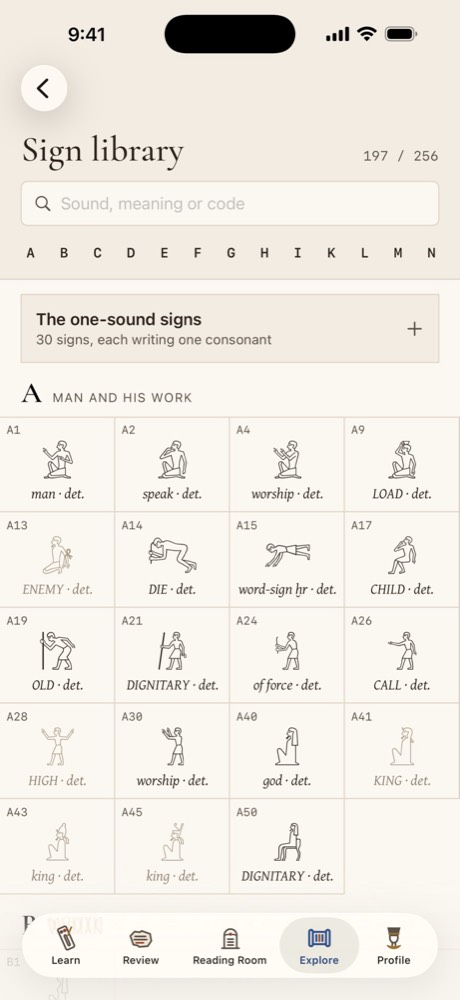
Units I and II, First Names and Champollion’s Path: which way to read, how signs stack, and the cartouches Champollion used to crack the script. Lesson 9 ends on a real object, every sign of it: a faience menat with the royal name Ptolemy (The Met 2021.41.14).
Signs are shown here in a row; on the objects some sit stacked in blocks, which lesson 4 teaches you to read in the right order.
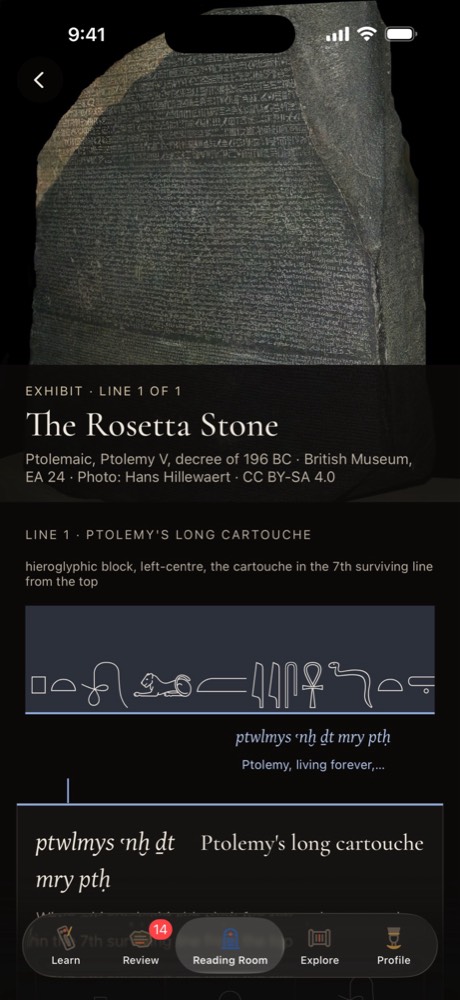
Gods’ names, the king’s names, dates, titles, family and the offering formula. Stage I ends on a complete Middle Kingdom stela, the stela of the governor Nakhti (British Museum EA 143): formula, owner, titles and family, then the Reader I certificate, earned on a text you have never seen.
“An offering which the king gives to Osiris, lord of Busiris, the great god, lord of Abydos, so that he may grant an invocation offering of bread and beer, cattle and fowl, alabaster and linen…”
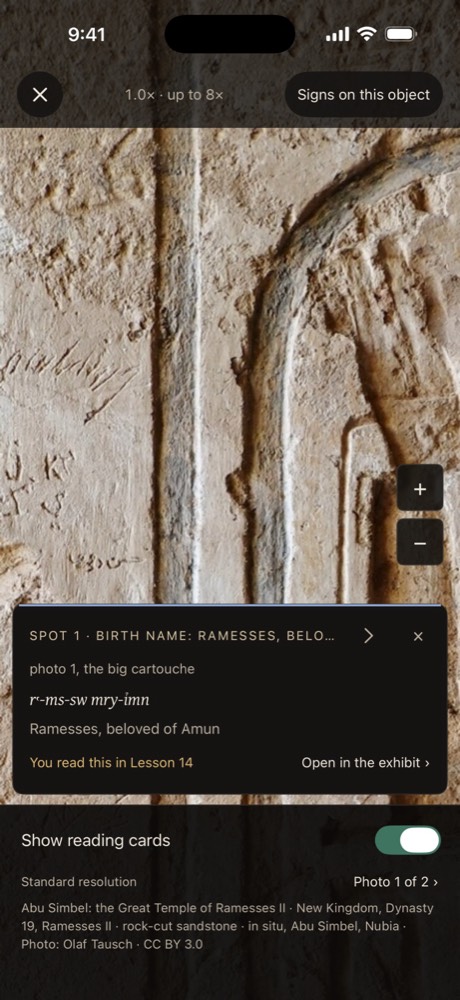
Stage II brings sentences and biographies, Stage III the whole verb system. Stage IV reads temples, the Book of the Dead, the Shipwrecked Sailor, the Eloquent Peasant, letters, a maths problem and a medical prescription, with eleven lessons on Sinuhe. The course closes with the Scribe certificate, earned on a text you have never seen.