
 Türkçe
 Deutsch
 Français
Hieroglyphs for beginners: your first 20 signs.
Begin with royal names. In Sesh’s first nine lessons you learn 20 signs and 8 words, enough to read Khufu, Pepi, Ptolemy and Cleopatra, and then a king’s name on a real object in the Metropolitan Museum. Below: every sign and word, a one-week plan and the seven traps nearly every beginner falls into.
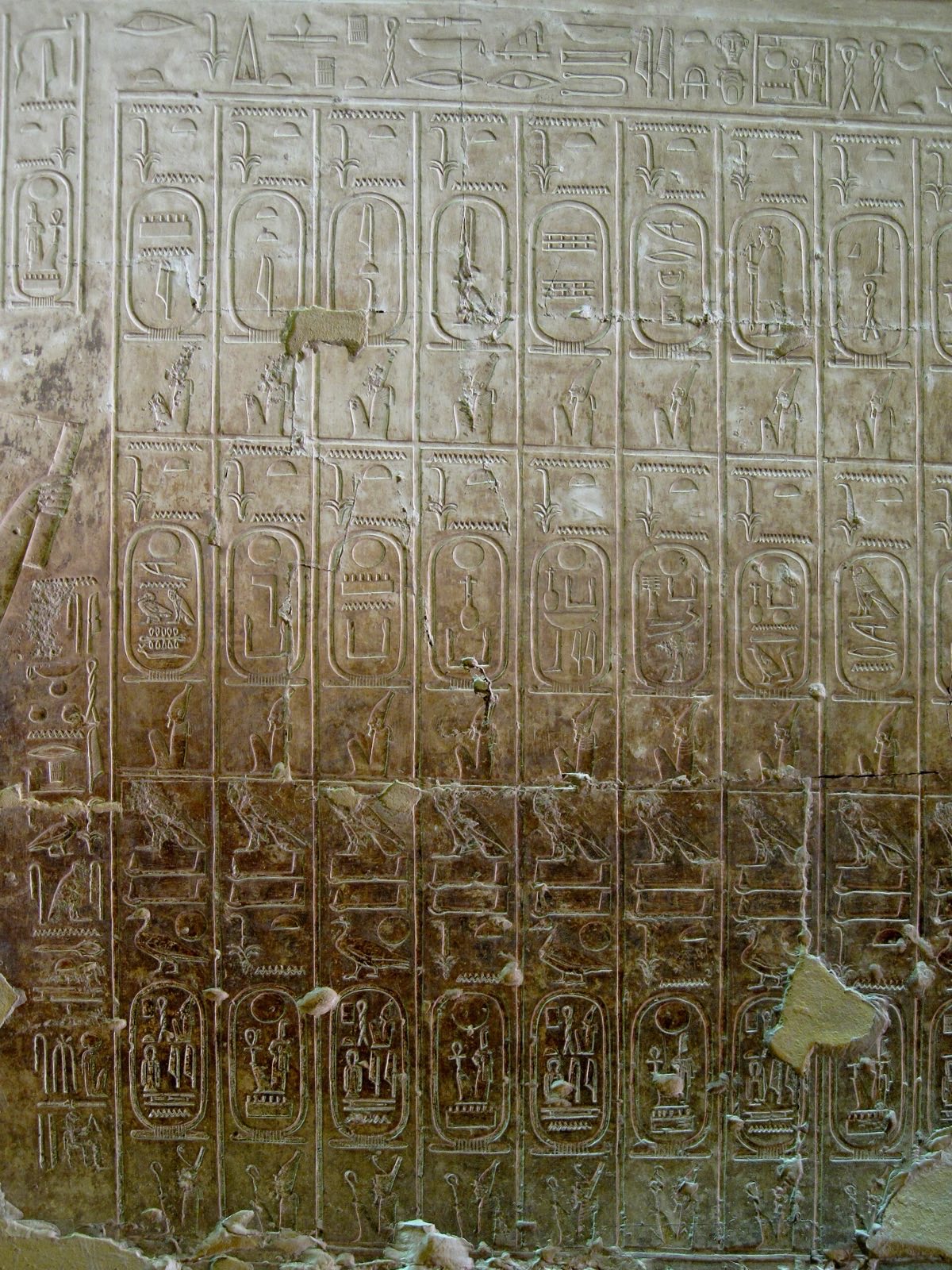
I · WHERE TO BEGINStart with royal names
Most courses, and Sesh, start where the decipherment started: with kings’ names. A name in an oval ring, the cartouche, tells you exactly where a word begins and ends, and royal names are spelled mostly with sound signs. That means you can read something real on day one, then add grammar later.
This page is the practical companion to the cornerstone guide, How to read Egyptian hieroglyphs. That guide explains the whole system; this one gives you a concrete start: the signs and words of Sesh’s first nine lessons, the names they unlock, a plan for your first week and the mistakes to avoid. The cartouche itself has its own guide: The Egyptian cartouche.
II · 20 SIGNSYour first 20 signs
These are the twenty signs a learner meets in lessons 1 to 9, in the order they arrive. Seventeen write sounds. Three do not: the cartouche is a frame, and the land sign and the egg are silent determinatives.
III · 8 WORDSYour first 8 words
With those signs you can read eight words: four names and four words that turn up again and again on royal objects.
| Hieroglyphs | Transliteration | Meaning | Lesson |
|---|---|---|---|
| 𓐍𓅱𓆑𓅱 | ḫwfw | Khufu (royal name) | L01 |
| 𓊪𓊪𓇋𓇋 | ppy | Pepi (royal name) | L02 |
| 𓊪𓏏𓍯𓃭𓐝𓇋𓇋𓋴 | ptwlmys | Ptolemy (Greek royal name, Ptolemaios) | L05 |
| 𓋹 | ꜥnḫ | life; to live | L06 |
| 𓆓𓏏𓇾 | ḏt | eternity; forever | L06 |
| 𓊪𓏏𓎛 | ptḥ | Ptah (god) | L06 |
| 𓌻 | mry | beloved (of) | L06 |
| 𓈎𓃭𓇋𓍯𓊪𓄿𓂧𓂋𓄿𓏏𓆇 | qlỉw-pꜣ-drꜣ(t) | Cleopatra (Greek queen's name) | L07–L08 |
IV · READ THEMFour royal names you can now read
Champollion checked his idea exactly this way: if the signs are sounds, the stool, the lasso and the lion must appear in both Ptolemy and Cleopatra, each where the Greek needs it. They do. By lesson 6 you can also read a longer royal ring, from a gilded silver band at the Metropolitan Museum:
V · ONE WEEKA one-week starter plan
About ten minutes a day is enough. Each day, first spend a few minutes reviewing yesterday’s signs, then do the new lesson, then copy the day’s name by hand once. Writing the signs yourself fixes their shapes faster than looking at them.
- DAY1KhufuThree sound signs and the cartouche. Read the name of the Great Pyramid’s builder on a relief in the Met.L014 min
- DAY2PepiThe stool and the reed; two reeds make y. Why there are no vowels.L026 min
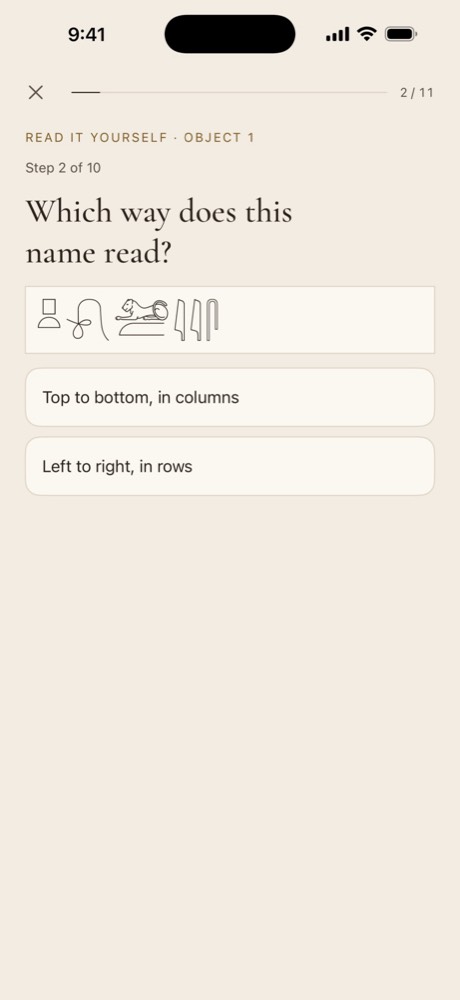
- DAY3Which way?Follow the faces; top before bottom; captions face their figure. Read Khufu and Pepi in every direction.L036 min
- DAY4BlocksSigns packed into squares. The loaf t. A first look at the three jobs a sign can do.L046 min
- DAY5Ptolemy and “living forever”Champollion’s first name, then the ankh, ḏt and Ptah: a whole royal ring.L05–L0614 min
- DAY6CleopatraFour new sounds, the feminine t and your first silent sign, the egg.L07–L0814 min
- DAY7Your first real objectNo help this time: read the king’s name on a faience menat counterweight in the Metropolitan Museum (2021.41.14).L0912 min
VI · AVOID THESESeven beginner traps
When you are ready to go further than names, the cornerstone guide walks through sentences and a whole stela. If you would like to know what the full course offers someone starting from zero, see Sesh for beginners.
 How Sesh helps
Lessons 1 to 9 are free. Start with Khufu today.
Everything on this page is the first two units of Sesh: four minutes for your first royal name, twelve for your first real object. Each sign comes back in spaced review just before you would forget it, and each rule names its source.
- No account needed; works offline on iPhone and iPad
- From these 20 signs to 256, and from Khufu to the Story of Sinuhe
- A translator converts. Sesh teaches you to read.
iPhone and iPad · iOS 17 or later
References
- Gardiner, Alan H. Egyptian Grammar: Being an Introduction to the Study of Hieroglyphs. 3rd edition, revised. Oxford: Griffith Institute, Ashmolean Museum, 1957.
- Allen, James P. Middle Egyptian: An Introduction to the Language and Culture of Hieroglyphs. 3rd edition. Cambridge: Cambridge University Press, 2014.
- Faulkner, Raymond O. A Concise Dictionary of Middle Egyptian. Oxford: Griffith Institute, 1962.
- Collier, Mark, and Bill Manley. How to Read Egyptian Hieroglyphs: A Step-by-Step Guide to Teach Yourself. Revised edition. London: British Museum Press, 1998.
- Leprohon, Ronald J. The Great Name: Ancient Egyptian Royal Titulary. Edited by Denise M. Doxey. Writings from the Ancient World 33. Atlanta: Society of Biblical Literature, 2013.
- Sesh course, units 1–2 (lessons L01–L09) and sign library, with the objects named above from The Metropolitan Museum of Art and the British Museum.
- Sesh: Learn Hieroglyphs (iOS app), course, Reading Room and sign library content, version of November 2026. Each lesson card names its source in the works above.
Sesh app content cited as “Sesh, lesson L…” or “Sesh Reading Room” is the app’s own teaching text, itself sourced to the works above. Photos are credited under each image. Not affiliated with the museums shown.