
 Türkçe
 Deutsch
 Français
Egyptian phonograms.
Phonograms are hieroglyphs used for their sound. Each writes one, two or three consonants, never vowels. The roughly two dozen one-consonant signs are often called the hieroglyphic alphabet, but that is a modern teaching shortcut: the Egyptians always mixed them with other signs.
I · DEFINITIONSigns that stand for sounds
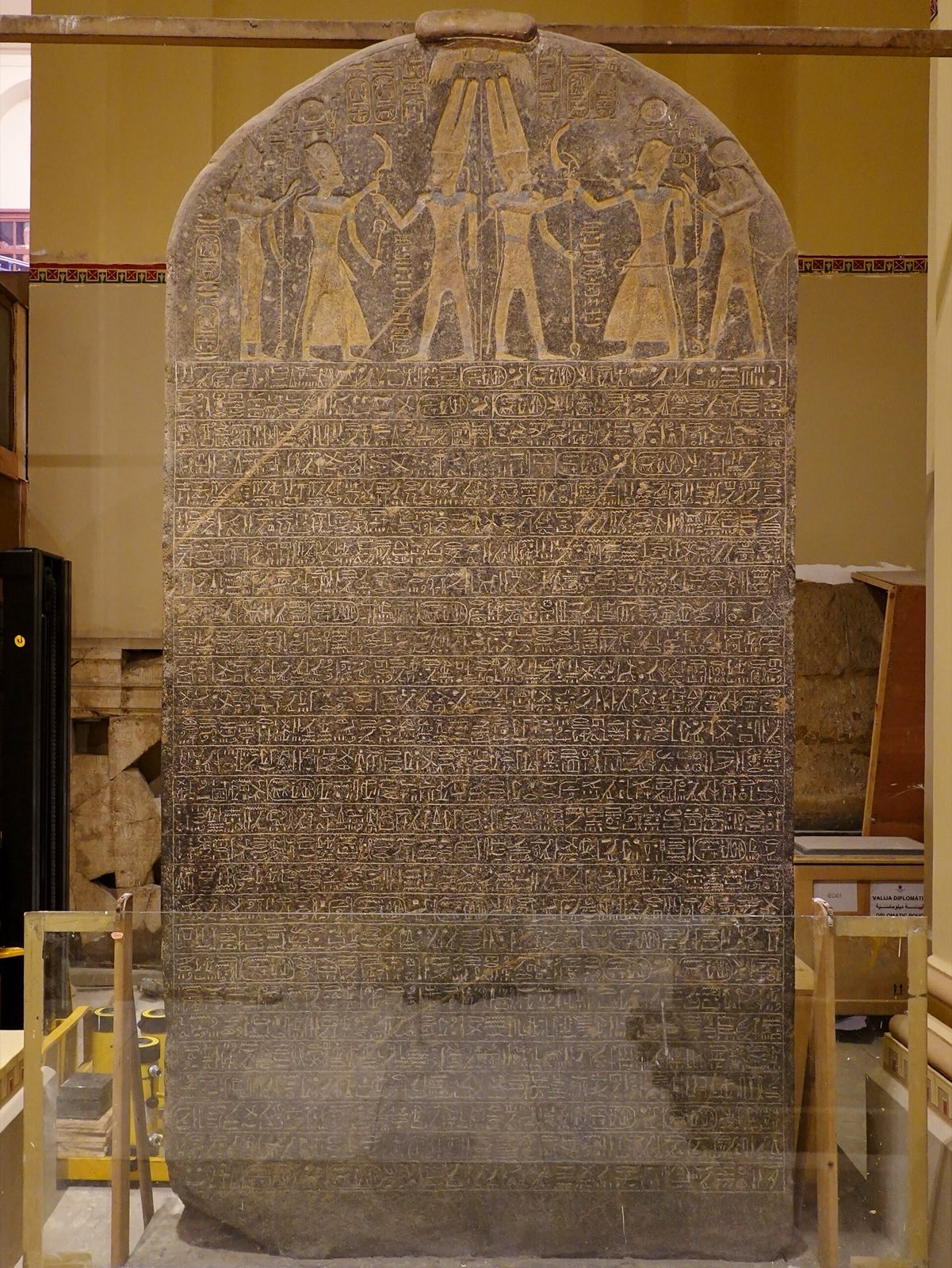
A phonogram is a hieroglyph used for its sound, not for what it shows. The owl writes the consonant m whether or not the word has anything to do with owls. Phonograms are the backbone of the script: most words are spelled with them, then finished off with a silent determinative.
Egyptian phonograms write consonants only, and a single sign can write one, two or three of them. Egyptologists call these uniliteral, biliteral and triliteral signs; in plain English, one-, two- and three-consonant signs. No sign writes more than three.
II · ONE CONSONANTThe one-consonant signs
About two dozen signs each write a single consonant. Gardiner lists them on page 27 of his grammar, and every course teaches them first. His table has 24 entries, with the door bolt and the folded cloth sharing one row as s; Allen’s has 25, because it keeps the bolt apart as z, a sound that had merged with s by the Middle Kingdom. Two reeds or two strokes for y, the curl for w and the red crown for n are second signs for sounds already in the table, not extra letters. They are given here in Egyptian dictionary order; the four kinds of h come in a row.
| Sign | Gardiner | Sound | What it shows | How Egyptologists say it |
|---|---|---|---|---|
| 𓄿 | G1 | ꜣ | An Egyptian vulture | a consonant (“aleph”); said “a” by convention |
| 𓇋 | M17 | ỉ | A flowering reed | said “i” by convention; some books write j |
| 𓇋𓇋 | M17 ×2 | y | Two flowering reeds | as in “yes”; two reeds, or two strokes 𓏭 at the end of a word |
| 𓂝 | D36 | ꜥ | A forearm, palm up | a deep throat sound absent from English; said “a” by convention |
| 𓅱 | G43 | w | A quail chick | said “oo” or “u”; also written with a curl 𓏲 |
| 𓃀 | D58 | b | Lower leg and foot | as in English |
| 𓊪 | Q3 | p | A stool | as in English |
| 𓆑 | I9 | f | A horned viper | as in English |
| 𓅓 | G17 | m | Owl | as in English |
| 𓈖 | N35 | n | A ripple of water | as in English; also the red crown 𓋔 |
| 𓂋 | D21 | r | A mouth | as in English |
| 𓉔 | O4 | h | Reed shelter | as in “house” |
| 𓎛 | V28 | ḥ | A wick of twisted flax | a stronger, breathy h from the throat |
| 𓐍 | Aa1 | ḫ | Uncertain; Gardiner: perhaps a placenta | “kh”, like ch in Scottish “loch” |
| 𓄡 | F32 | ẖ | Animal's belly with udder | softer, perhaps like German “ich” |
| 𓊃 | O34 | s | Door bolt | originally z; Allen writes z |
| 𓋴 | S29 | s | A folded cloth | as in English |
| 𓈙 | N37 | š | A pool | “sh” |
| 𓈎 | N29 | q | A sandy hill-slope | a k made far back in the throat |
| 𓎡 | V31 | k | Basket with a handle | as in English |
| 𓎼 | W11 | g | Jar stand | hard g, as in “go” |
| 𓏏 | X1 | t | A loaf of bread (flat, half-round) | as in English |
| 𓍿 | V13 | ṯ | Tethering rope | usually said “tj” or “ch” |
| 𓂧 | D46 | d | A hand | as in English |
| 𓆓 | I10 | ḏ | A cobra | like the j in “jet” |
III · THE “ALPHABET”Is there a hieroglyphic alphabet?
Only as a teaching device. The “hieroglyphic alphabet” is the modern name for the one-consonant signs, gathered into a chart so learners can start somewhere.
Gardiner himself heads his table of these signs “alphabet”, and it is a useful shortcut. But the Egyptians never wrote with them alone, the way we use A to Z. They mixed them freely with two- and three-consonant signs, word signs and silent determinatives, even when a word could have been spelled with one-consonant signs only. The mixture gave variety, and it made words easy to spot in a script without spaces.
Three things separate the chart from a real alphabet:
- No vowels. There is no sign for a, e, i, o or u. A chart that gives you an “e” or an “o” has borrowed a consonant sign and given it a modern job.
- No l, and no v. Egyptian had no separate l-sign; when scribes wrote Greek names such as Ptolemy and Cleopatra, they used the lying lion 𓃭 (normally rw) for l and the lasso 𓍯 (normally wꜣ) for o.
- Not one sign per sound. Several signs can write the same consonant: the loaf and the hand both write Greek t in Ptolemy and Cleopatra.
There is a twist to the story. Workers from the Levant at the Egyptian turquoise mines of Serabit el-Khadim borrowed hieroglyph shapes to write their own language, one sign per sound. An ox head, a house and water became letters that, many steps later, gave us A, B and M. Egyptian never became an alphabet; it helped to inspire one.
IV · TWO CONSONANTSThe two-consonant signs
Many signs write two consonants at once. These are the ones a Sesh learner meets most often, with the lesson where each first appears.
| Sign | Gardiner | Sound | What it shows | In Sesh |
|---|---|---|---|---|
| 𓏠 | Y5 | mn | A senet board with its playing pieces, seen from the side | L11 |
| 𓄟 | F31 | ms | Three fox skins tied together | L14 |
| 𓇓 | M23 | sw | A sedge plant | L14 |
| 𓌻 | U7 | mr | A hoe | L14 |
| 𓉐 | O1 | pr | Plan of a house | L21 |
| 𓎟 | V30 | nb | Basket | L21 |
| 𓅭 | G39 | sꜣ | Pintail duck | L21 |
| 𓅮 | G40 | pꜣ | A pintail duck in flight | L56 |
| 𓅨 | G36 | wr | Swallow (forked tail) | L22 |
| 𓂓 | D28 | kꜣ | Two raised arms | L22 |
| 𓌢 | T22 | sn | Arrowhead | L22 |
| 𓁹 | D4 | ỉr | Eye | L22 |
| 𓉻 | O29 | ꜥꜣ | Wooden column, lying on its side | L26 |
| 𓈞 | N41 | ḥm | Well with water | L33 |
| 𓏇 | W19 | mỉ | Milk jug in a carrying net | L33 |
| 𓌃 | S43 | md | A walking staff | L64 |
| 𓈍 | N28 | ḫꜥ | Sun's rays rising over a hill | L31 |
| 𓄋 | F13 | wp | A pair of horns | L63 |
V · THREE CONSONANTSThe three-consonant signs
A smaller group writes three consonants. Many of them also stand for a whole word on their own: the ankh is ꜥnḫ “life”, the scarab ḫpr “come into being”, the heart and windpipe nfr “good, beautiful”.
| Sign | Gardiner | Sound | What it shows | In Sesh |
|---|---|---|---|---|
| 𓋹 | S34 | ꜥnḫ | Gardiner: a sandal strap. The original object is debated. | L06 |
| 𓄤 | F35 | nfr | Heart and windpipe | L23 |
| 𓆣 | L1 | ḫpr | Scarab beetle | L23 |
| 𓊵 | R4 | ḥtp | A loaf on a reed mat (an offering table) | L13 |
| 𓋾 | S38 | ḥqꜣ | A crook (shepherd's staff), the ruler's sceptre | L12 |
| 𓊹 | R8 | nṯr | Cloth (flag) on a pole | L23 |
| 𓄔 | F21 | sḏm | An ear (of a cow) | L60 |
| 𓄊 | F12 | wsr | Head and neck of a canine | L23 |
| 𓊢 | P6 | ꜥḥꜥ | A ship's mast | L74 |
| 𓍉 | U21 | stp | Adze on a block of wood | L31 |
| 𓌞 | T18 | šms | A crook with a bundle tied to it | L82 |
| 𓏃 | W17 | ḫnt | Water jars standing in a rack | L41 |
| 𓇛 | M29 | nḏm | A carob pod | L124 |
| 𓄥 | F36 | smꜣ | Lung and windpipe | L110 |
| 𓄙 | F25 | wḥm | Leg and hoof of an ox | L109 |
VI · READING HELPSHow phonetic complements work
Two- and three-consonant signs often travel with one or two one-consonant signs that repeat part of their sound. These phonetic complements confirm the reading; they are not pronounced a second time. Usually they repeat the last consonant, sometimes more.
One question tells you whether a small sign is a complement or a new sound: does it repeat a sound the big sign already has? If yes, read it once: 𓏠𓈖 is mn, not mnn. If no, it is new: in 𓎟𓏏 nbt “lady”, the loaf adds a real t, the feminine ending.
VII · WORKED EXAMPLEA king’s name on a real stela
Here is the whole system at work in four words from the top band of a Middle Kingdom stela in the Metropolitan Museum: the title “Son of Ra” followed by the king’s name, Amenemhat.
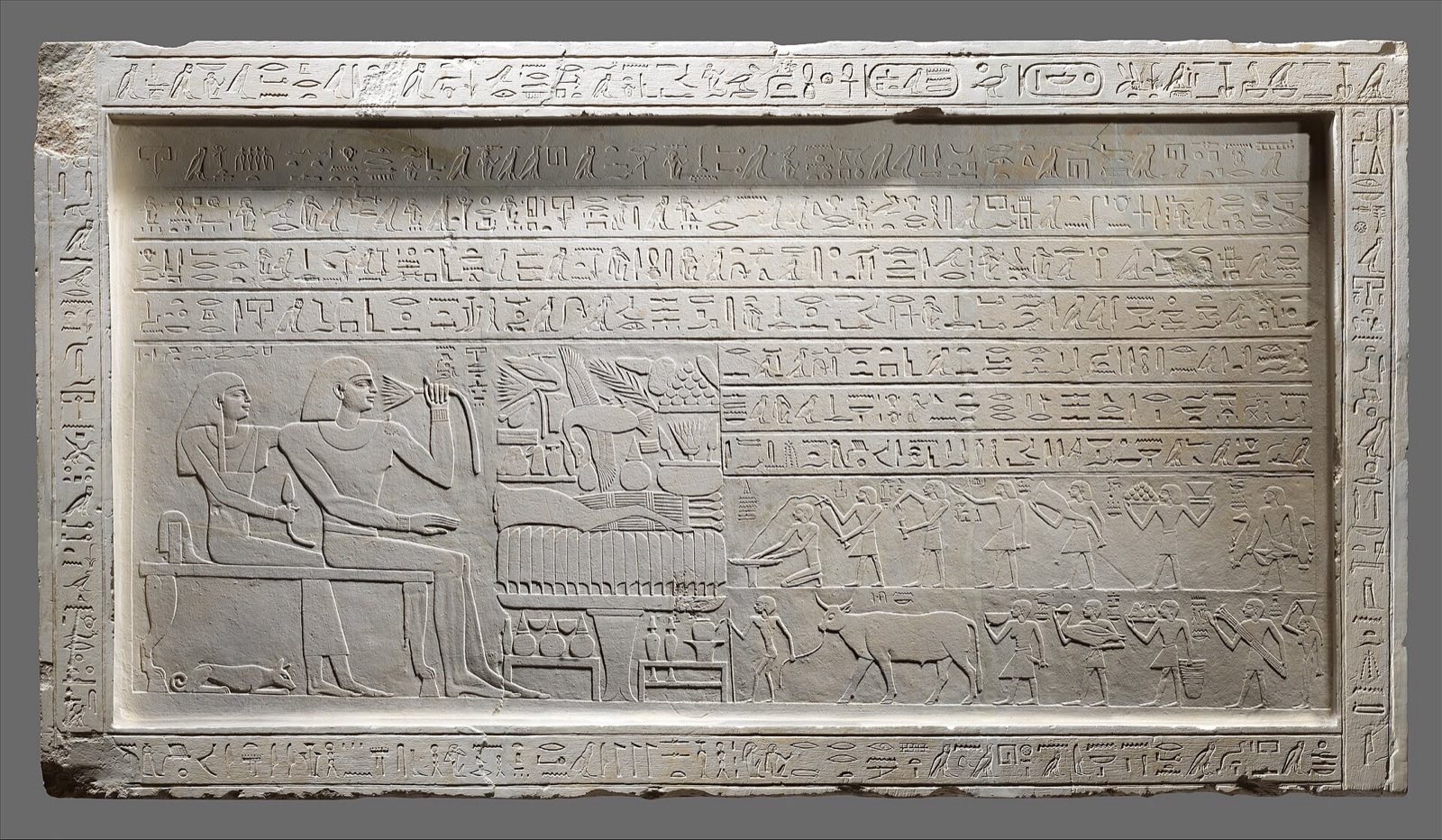
Read it as a chain: sꜣ + rꜥ, then ỉ + mn (the water confirms the n) = ỉmn, Amun; m, “at”; and ḥꜣt (the loaf confirms the t), “front”. Amun-is-at-the-front: Amenemhat. In Sesh you read this band in the Reading Room once you reach lesson 29.
For the signs that are not phonograms, read Egyptian determinatives, explained. For how Egyptologists write all this in Latin letters, see Egyptian transliteration.
 How Sesh helps
All 256 signs, in a library you can search by sound.
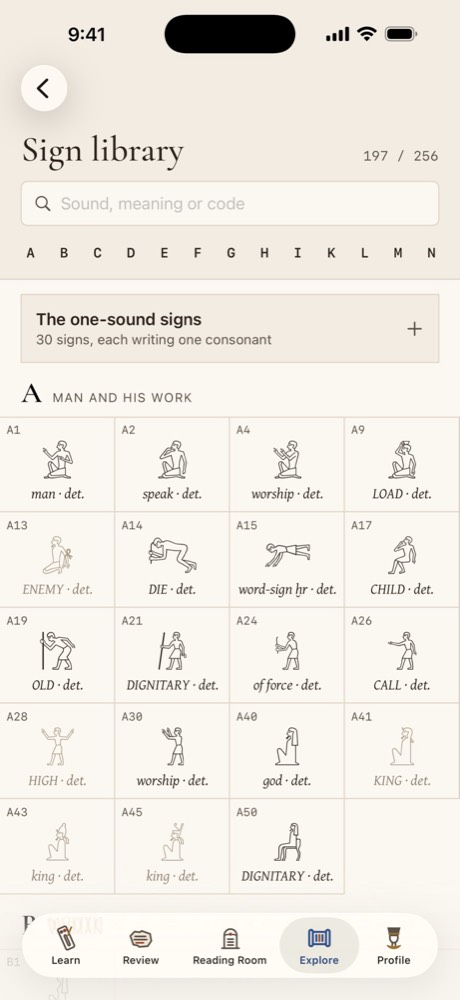
Sesh teaches each phonogram when you need it, inside real names and texts, then brings it back in spaced review just before you would forget it. The sign library sorts every sign by Gardiner’s categories and lets you search by sound, meaning or code.
- Each sign with its sound, its picture, its jobs and the lesson where you met it
- Phonetic complements and determinatives marked in every reading
- Lessons 1 to 9 are free, no account needed
iPhone and iPad · iOS 17 or later
References
- Gardiner, Alan H. Egyptian Grammar: Being an Introduction to the Study of Hieroglyphs. 3rd edition, revised. Oxford: Griffith Institute, Ashmolean Museum, 1957.
- Allen, James P. Middle Egyptian: An Introduction to the Language and Culture of Hieroglyphs. 3rd edition. Cambridge: Cambridge University Press, 2014.
- Faulkner, Raymond O. A Concise Dictionary of Middle Egyptian. Oxford: Griffith Institute, 1962.
- Collier, Mark, and Bill Manley. How to Read Egyptian Hieroglyphs: A Step-by-Step Guide to Teach Yourself. Revised edition. London: British Museum Press, 1998.
- Sesh Reading Room: “Stela of the Overseer of the Fortress Intef” (The Metropolitan Museum of Art 57.95) and “The Serabit Sphinx” (British Museum EA 41748).
- Sesh: Learn Hieroglyphs (iOS app), course, Reading Room and sign library content, version of November 2026. Each lesson card names its source in the works above.
Sesh app content cited as “Sesh, lesson L…” or “Sesh Reading Room” is the app’s own teaching text, itself sourced to the works above. Photos are credited under each image. Not affiliated with the museums shown.